
AI Competitor Analysis: Why Manual Research No Longer Works
Note that competitors in this Example are purely for this test process and do not necessarily reflect real active competitor research.
How we built an AI driven competitor intelligence workflow to track market signals, analyse positioning, messaging, and proof points, so marketing, sales, and leadership teams can spend less time gathering information and more time acting on it.
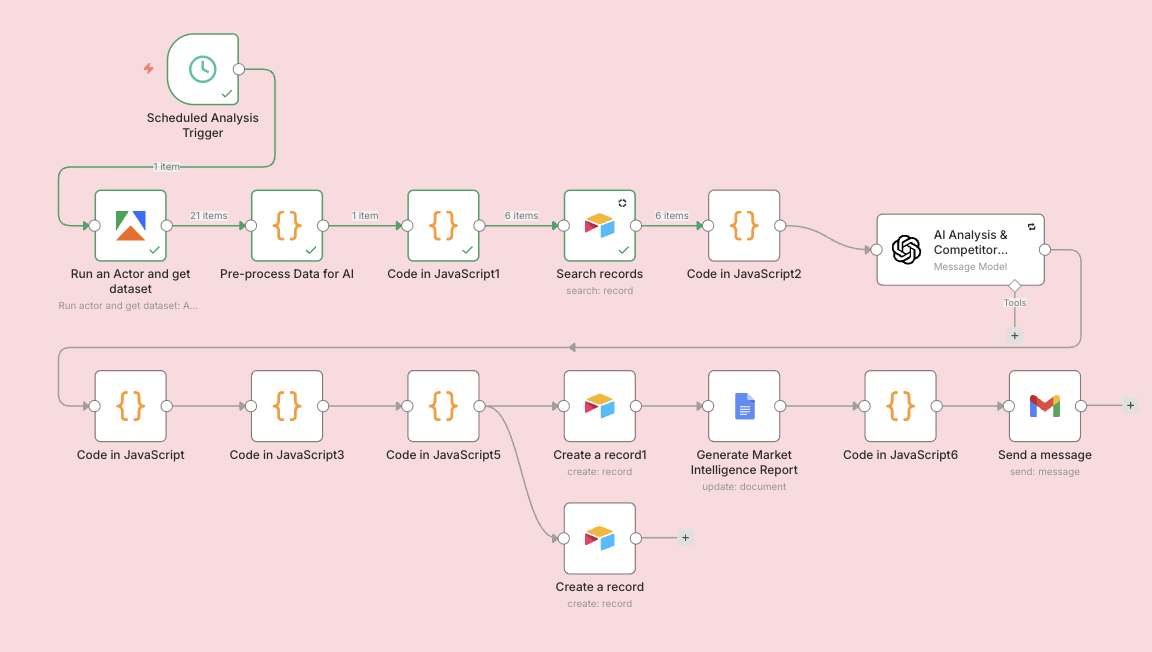
The Research Strategy workflow: scraping competitor pages, comparing current evidence with previous records, generating structured analysis, and writing outputs into a reporting layer.
Introduction
Strategic market and competitor analysis remains critical for marketing, sales, and leadership teams. Understanding how competitors position themselves, communicate value, and demonstrate proof points directly influences commercial performance. However, in many organisations, competitor analysis is still largely manual. Research is spread across screenshots, spreadsheets, copied notes, and occasional reviews that are already outdated by the time they are shared.
As a result, marketing teams spend too much time gathering information rather than using it. Sales teams lose time piecing together competitor claims instead of focusing on pipeline and conversion. Leadership receives fragmented updates instead of structured intelligence.
This creates a real commercial cost.
To address this, we built an AI driven competitor intelligence workflow designed to reduce manual effort, improve consistency, and generate structured insights that teams can act on.
What is AI competitor intelligence
AI competitor intelligence refers to the use of artificial intelligence within structured workflows to collect, analyse, and interpret competitor data in a consistent and repeatable way. Rather than relying on manual research, AI is used to gather signals, compare them over time, and generate insights that support commercial decision making. This approach transforms competitor analysis from an occasional task into an ongoing system.
The problem with manual competitor research
Manual research still has value, but it does not scale effectively. Once a business needs to track multiple competitors across positioning, messaging, service offerings, case studies, reviews, and proof points, the process becomes slow and inconsistent. A one-off review is manageable. Continuous competitor monitoring is where the strain becomes clear. The typical workflow is familiar. Teams open multiple websites, copy relevant content, summarise what appears important, and repeat the same process at a later date. This is not a structured intelligence system. It is a recurring research task.
The cost is not only time. It is inconsistency. Different individuals capture different signals, use different formats, and interpret changes differently. This makes competitor analysis difficult to compare, maintain, and act upon. This is where AI workflow automation becomes essential to make competitor analysis consistent, scalable, and commercially useful.
Building an AI driven competitor intelligence workflow
To address these limitations, we built a structured workflow to automate key parts of the competitor intelligence process.
The system performs several core functions. It scrapes selected competitor pages, groups the evidence by competitor, and compares current signals against previous records to establish context. AI is then used to identify the most important signal, structure the output into a commercial format, and generate a recommended response. The results are written into a tracking system and compiled into a readable report. The objective was not to replace human judgement. It was to reduce the manual burden of collecting, cleaning, comparing, and summarising competitor data.
What the workflow analyses
The current workflow focuses on visible competitor signals from public sources. These include positioning and messaging, service and offer framing, case studies and proof points, client reviews, and broader trust signals. Each signal is analysed not just for what has changed, but for why it matters commercially. The output includes a clear summary, an assessment of the impact, and a recommended response.
Over time, this type of workflow can evolve into a broader market intelligence system. Even at this stage, it significantly improves the structure and speed of competitor monitoring.
The technology stack
The workflow was built using a combination of tools, including Apify for data scraping, n8n for orchestration, OpenAI for analysis and structured outputs, Airtable for data storage, and Google Docs for reporting.
However, the tools are not the primary source of value. The impact comes from how the workflow is designed. Grouping data correctly, comparing it against historical baselines, and structuring outputs into a consistent commercial format are what make the system useful. Without this structure, AI simply produces unstructured summaries.
What worked in practice
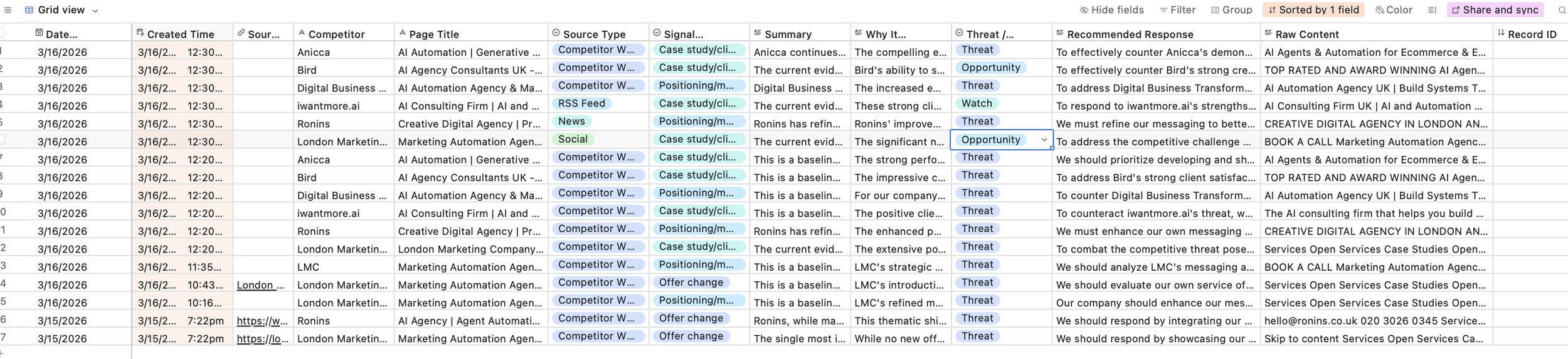
Structured competitor signals written into Airtable for ongoing tracking, comparison, and review.

Airtable summary
The most important outcome was that competitor monitoring became a repeatable process rather than an ad hoc task. Instead of rebuilding research manually, the workflow continuously gathers inputs, compares them against previous records, generates structured analysis, and stores outputs for future tracking. This enables ongoing visibility into competitor activity rather than periodic snapshots. It also demonstrated that AI performs best when the task is clearly defined. Asking for one key signal, its commercial relevance, and a recommended response produces far more actionable insights than broad, unstructured analysis.
Example output: structured competitor intelligence
A typical output includes a clearly defined signal, its commercial relevance, and a recommended response.
For example, a competitor increasing its number of client reviews may be identified as a strengthening trust signal. The system highlights why this matters, such as increased credibility and improved conversion potential, and recommends actions such as strengthening case study development and client proof. This format ensures that outputs are not just descriptive, but directly useful for marketing and sales teams.
Final Report Output and Recommendations
Competitor: LMC
Signal Category: Case study/client proof
Threat / Opportunity / Watch: Threat
Summary:
The current evidence strengthens the previous baseline, highlighting that London Marketing
Company has successfully accumulated over 220 five-star reviews from various clients, which
underscores their high levels of customer satisfaction. This feedback reflects their effectiveness
in achieving measurable results for clients, enhancing their credibility and reputation in the
marketplace.
Why It Matters:
The significant number of positive client testimonials suggests that London Marketing Company
is effectively meeting the needs of their customers and generating results that resonate with the
market. This proficiency positions them as a formidable competitor, capable of attracting new
clients and potentially overshadowing our offerings unless we elevate our own client
engagement and demonstrable success.
Recommended Response:
To address the competitive challenge posed by London Marketing Company's strong client
success narrative, we should focus on systematically gathering and showcasing our own client
testimonials, success stories, and case studies. Enhancing our service delivery and client
relationships will be crucial to increasing satisfaction, therefore leading to more positive reviews
and strengthening our positioning in the market.
----------------------------------------Competitor: Ronins
Signal Category: Positioning/message shift
Threat / Opportunity / Watch: Threat
Summary:
Ronins has refined its marketing narrative to emphasize AI automation integration within their
digital solutions. This clearer positioning enhances their appeal and strengthens their
competitive edge in the market.
Why It Matters:
Ronins' improved messaging positions them as a strong contender for clients seeking cohesive
and technologically advanced digital solutions, which overlaps with our target market. This shift
could lead to an increased share of clients who value the intersection of creativity and
technology.Recommended Response:
We must refine our messaging to better highlight how our AI automation seamlessly integrates
with our overall marketing services. By focusing on the synergistic effects of our offerings and
providing concrete examples, we can effectively differentiate ourselves from Ronins. Continually
monitoring their messaging will be essential to stay competitive.
----------------------------------------Competitor: iwantmore.ai
Signal Category: Case study/client proof
Threat / Opportunity / Watch: Threat
Summary:
The current evidence confirms the previous baseline, highlighting iwantmore.ai's capability to
identify over 60 AI and automation use cases for clients like Opinium, along with strong
endorsements from key executives at Midwich Group and Attwells Solicitors LLP. The emphasis
on producing tangible outcomes for businesses reinforces their credibility in the market.
Why It Matters:
These strong client testimonials and documented success stories indicate iwantmore.ai's
effective approach to delivering tailored AI solutions, making them a formidable competitor. They
have built a solid reputation and demonstrated a capacity to meet specific client needs, which
could draw potential clients away from our offerings if we do not exhibit similar proof points.
Recommended Response:
To respond to iwantmore.ai's strengths, we need to enhance our visibility by compiling and
showcasing detailed case studies and testimonials from our clients that highlight successful
implementations. It is crucial to identify and articulate a significant number of AI use cases we
have developed for our clients to demonstrate our effectiveness and industry relevance.
----------------------------------------Competitor: Digital Business Transformation
Signal Category: Positioning/message shift
Threat / Opportunity / Watch: Threat
Summary:
Digital Business Transformation has sharpened its focus on delivering measurable ROI within
90 days, significantly enhancing the clarity of its value proposition. This messaging positions
them as a compelling choice for potential clients looking for quick and visible returns from AI
automation solutions.
Why It Matters:The increased emphasis on guaranteed outcomes indicates a potential risk for our company, as
clients are gravitating toward vendors who can demonstrate fast, tangible results. As
businesses prioritize swift, measurable impacts, we may face challenges in attracting and
retaining clients if our offerings are not effectively communicated.
Recommended Response:
To address Digital Business Transformation's strengthened positioning, we need to refine our
marketing communications to highlight our unique advantages, particularly any quantifiable
outcomes we can assert. Additionally, exploring an ROI guarantee or similar assurance might
enhance our appeal to prospective clients, fostering increased confidence in our service
effectiveness.
----------------------------------------Competitor: Bird
Signal Category: Case study/client proof
Threat / Opportunity / Watch: Threat
Summary:
The current evidence confirms the previous baseline, specifically highlighting Bird's strong client
satisfaction with numerous positive reviews averaging 4.9 to 5/5 ratings. This consistent
feedback underscores Bird's credibility as a leading provider of AI-driven solutions in the market.
Why It Matters:
Bird's ability to secure high client satisfaction ratings significantly enhances its reputation and
competitiveness. These testimonials likely influence potential clients' trust and decision-making,
indicating that they view Bird as a reliable choice for AI marketing services, which poses a direct
threat to our market positioning.
Recommended Response:
To effectively counter Bird's strong credibility, our company should actively gather and showcase
detailed client testimonials and case studies. Incorporating success stories into our marketing
materials will help to bolster our own reputation and highlight the impact of our services, making
our offerings more appealing to potential clients.
----------------------------------------Competitor: Anicca
Signal Category: Case study/client proof
Threat / Opportunity / Watch: Threat
Summary:Anicca continues to showcase its effectiveness through substantial case studies, including a
122% increase in ROAS for an e-commerce client. This data reinforces their reputation for
delivering measurable results in marketing automation, particularly in e-commerce sectors.
Why It Matters:
The compelling evidence of Anicca's success can significantly enhance its customer acquisition
efforts, allowing them to stand out as a preferred provider for potential clients. If they maintain
this momentum, our competitiveness in acquiring similar clients could diminish, necessitating a
proactive response.
Recommended Response:
To effectively counter Anicca's demonstrated market performance, we must prioritize creating
and publicizing our case studies that highlight our AI marketing automation successes.
Emphasizing tangible ROI and specific client scenarios will reinforce our credibility and create a
stronger value proposition to attract potential customers.
What did not work perfectly
As expected, the challenges were not in the AI itself, but in data quality and workflow discipline.
Issues included inconsistent competitor naming, noisy or irrelevant source content, weak input URLs, and occasional overinterpretation of minor changes. In addition, baseline data required cleaning before comparisons became reliable. These challenges highlight an important point. AI workflows depend on the quality and structure of the underlying data. Without disciplined inputs, outputs become less reliable. This is the difference between a working demonstration and a system that delivers ongoing value.
Why this matters commercially
The value of AI competitor intelligence is not limited to automation. It lies in what teams can do with the time and clarity they gain. For marketing teams, this means less time gathering information and more time refining positioning, messaging, and campaigns. For sales teams, it reduces the need to manually research competitors and allows greater focus on active opportunities, objection handling, and conversion. For leadership, it provides structured, consistent visibility into market signals without relying on fragmented updates.
This is where the real opportunity cost exists. High value commercial roles should not be spending significant time assembling basic competitor intelligence manually.
Conclusion: competitor analysis must evolve beyond manual processes
Strategic market and competitor analysis remains essential. However, manual approaches are too slow, inconsistent, and resource intensive to support ongoing market visibility. AI does not replace strategic thinking. It reduces the friction between raw competitor data and actionable commercial insight. Organisations that redesign competitor intelligence as a structured workflow will gain faster access to insights, improve decision making, and strengthen their competitive positioning.
Those that continue relying on manual processes risk falling behind.
Related Topics
Frequently Asked Questions
What is AI competitor analysis
AI competitor analysis is the use of artificial intelligence to collect, analyse, and interpret competitor data within a structured workflow, enabling faster and more consistent insights.
Why does manual competitor research not scale
Manual research becomes slow and inconsistent when tracking multiple competitors over time, making it difficult to maintain accurate and actionable insights.
How does AI improve market intelligence
AI improves market intelligence by automating data collection, comparing changes over time, and generating structured insights that support commercial decisions.
What tools are used in AI competitor intelligence workflows
Common tools include data scraping platforms, workflow automation tools, AI models for analysis, and data storage systems for tracking insights.
What is the main benefit of AI driven competitor intelligence
The main benefit is reducing manual effort while improving the speed, consistency, and usability of competitor insights across teams.
Final thought
AI will not replace strategic thinking in market analysis. But it will fundamentally change how competitor intelligence is gathered, structured, and used. That is where the real advantage lies.
Interested in building a similar workflow for your business?
I help companies identify where AI driven automation can reduce manual workload, improve intelligence gathering, and support better commercial decision-making.