
How to Build an AI Content System That Actually Works (Not Just Generates Content)
Ai Content Workflow Development
The problem with most AI content systems
Most AI content systems do not fail because of poor tools. They fail because they generate content without structure, prioritisation, or control. On the surface, the system appears productive. Articles are generated, posts are published, and output increases. However, over time, the quality and impact decline. Content becomes repetitive, messaging loses consistency, and engagement weakens. Despite producing more, the system delivers less commercial value. This is not a tooling issue. It is a system design problem. This reflects a broader issue in how AI is applied to decision making in marketing and sales workflows.
What most AI content workflows actually look like
Most workflows follow a linear and superficial process. Content is pulled from RSS feeds or scraped sources, passed through a language model, turned into an article, and then distributed across platforms such as LinkedIn or a website. This creates the illusion of automation, but it lacks any real decision-making. There is no filtering of inputs, no prioritisation of signals, and no alignment to audience or customer journey. Every input is treated equally, which results in generic outputs that lack relevance and differentiation.
Screenshot 1 — Current Workflow (n8n)
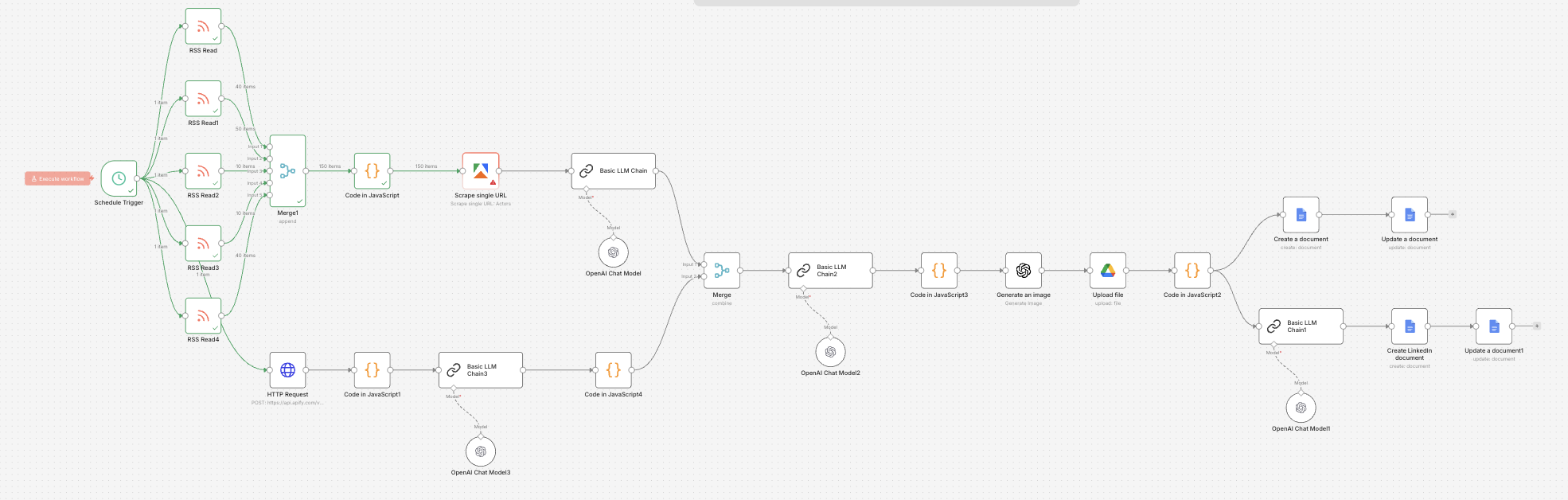
End to end AI content workflow built in n8n, from signal ingestion to multi channel output
The core mistake: content without a trigger
The fundamental issue is that content is being created because there is a need to publish, rather than because something meaningful has happened. In most systems, the primary trigger is the content calendar. Teams produce content because they need to fill slots, not because there is a compelling reason to communicate. A functional system operates differently. Content should be triggered by change, importance, or absence. Without this logic, the system defaults to producing volume rather than value.
What actually triggers content in a working system
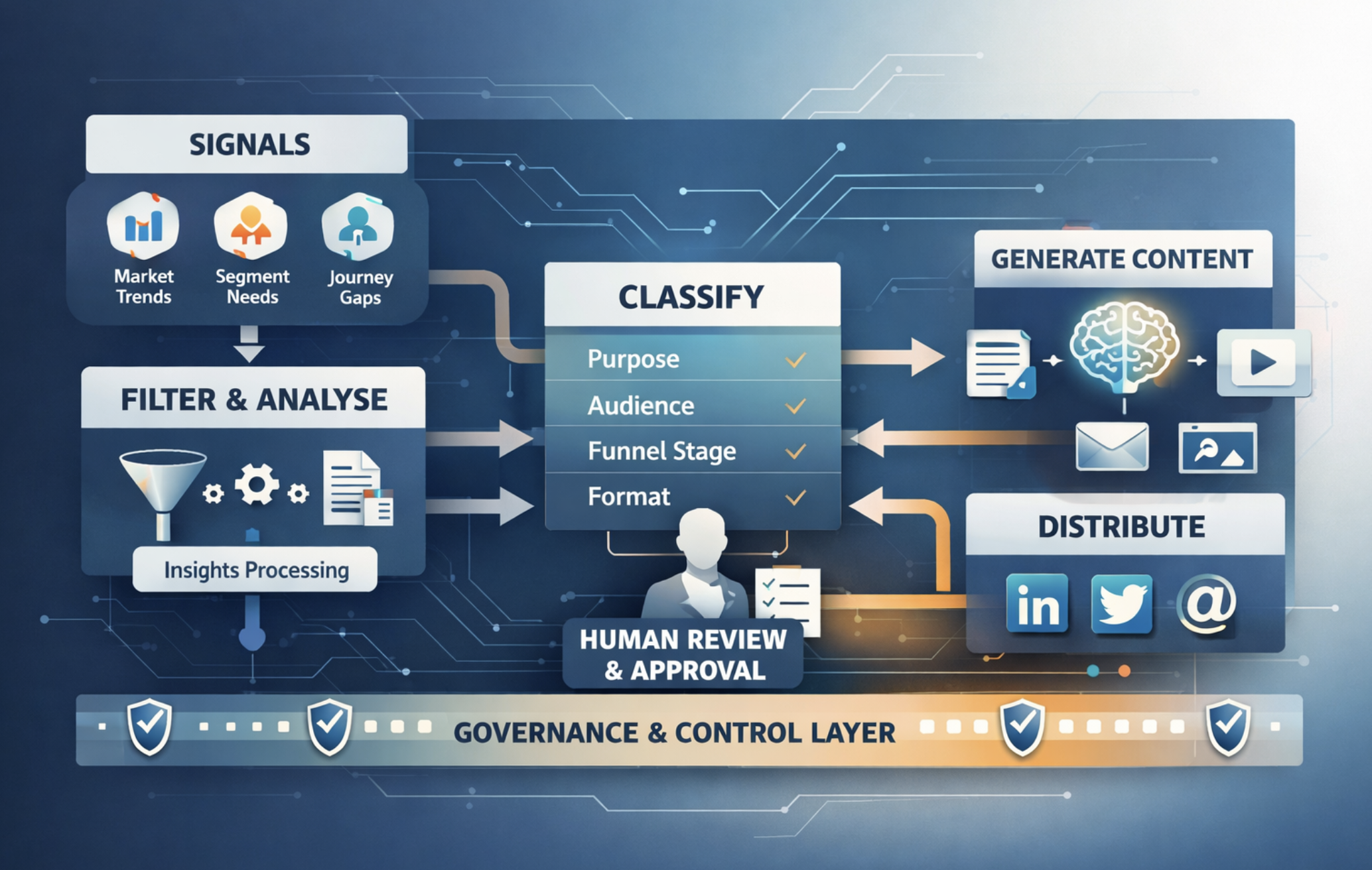
A structured content system is built around four types of triggers. Market signals capture external changes such as competitor movements, shifts in messaging, or emerging trends. Segment needs reflect recurring problems within a defined audience. Journey gaps identify missing content that prevents customers from progressing. Calendar triggers exist only to regulate cadence and should never determine what content is created. This hierarchy transforms content from reactive output into a structured response to real conditions. This is the foundation of a signal driven content approach.
The missing layer: content classification
Once a trigger is identified, the next step is to determine what the content should be. Most systems fail at this point because they move directly from input to output. They do not define the purpose, audience, or context of the content before generating it. This omission leads to uniform and unfocused outputs. Without classification, every piece of content becomes a generic article or post, regardless of its origin or intent.
Screenshot 2 — Content Generation Layer
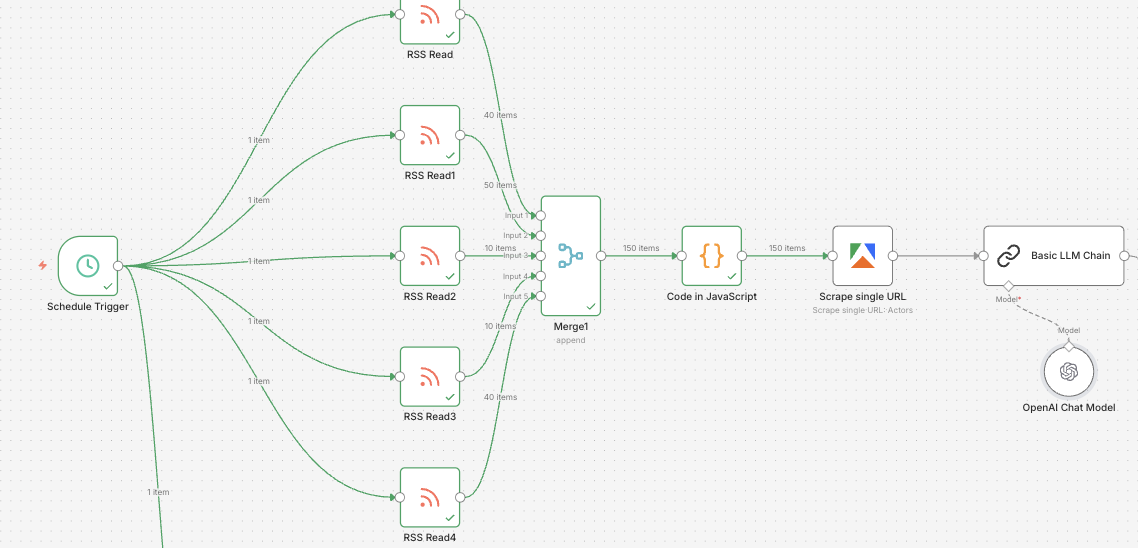
Layer 1 - RSS feeds merged + LLM prompt
This is the first process layer
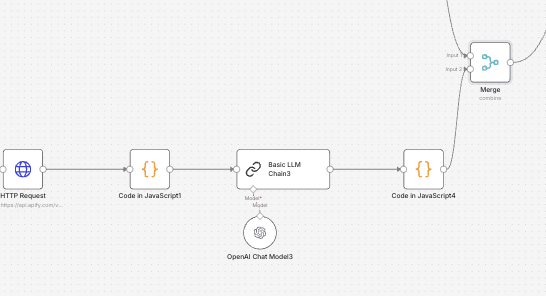
Layer 2 - Web scraping of Articles and relevant content, market signals etc
This is the second layer. This adds additional data into the system of market signals.
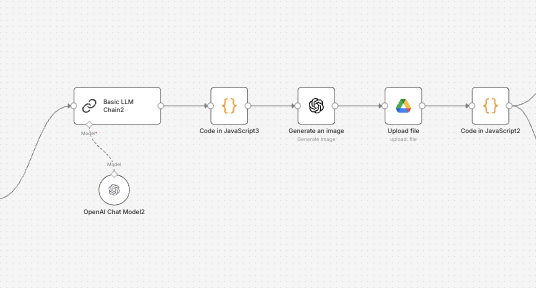
Layer 3 - LLM data summary + Image generation and output
This is layer 3, where all data is funneled, analysed and interpreted against the systems’ rules, formatting and important signals and output structure.
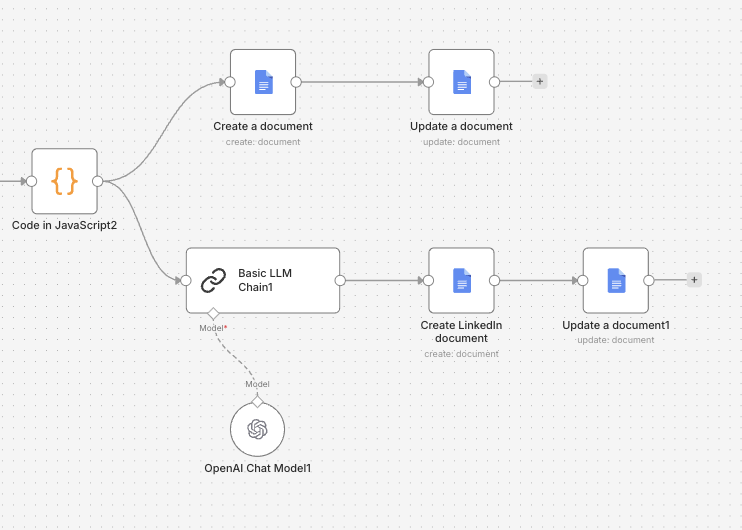
Layer 4 - Document Types, LLM formatting and Document Posting
The final layer is where a variety of formats and posting across various locations happens
What content classification actually does
Effective content classification defines four key dimensions. Purpose determines whether the content is intended to inform, provide insight, educate, or influence a decision. Audience defines who the content is for, such as a founder, operator, or marketing lead. Funnel stage determines where the content sits within the customer journey. Format determines how the content should be delivered, whether as a post, article, guide, or case.
This step introduces precision into the system. Instead of generating generic outputs, the system produces content that is aligned with a specific role and objective.
Example: how one signal becomes structured content
Consider a signal such as working parents leaving organisations. Without structure, this would result in a broad and unfocused article. With proper classification, it becomes a market signal, positioned as an insight-driven piece, targeted at operational leaders, aligned to the awareness stage, and delivered through both LinkedIn and a supporting article. The input remains the same, but the output becomes significantly more relevant and commercially meaningful.
The hidden risk most AI systems ignore
AI increases the speed of content production, but it also increases the speed at which errors can scale. Without control mechanisms, systems begin to introduce inconsistencies, inaccuracies, and messaging drift. Low-quality signals become published content. Analysis becomes detached from reality. Messaging loses coherence. Over time, this erodes credibility and reduces effectiveness, even as output increases.
Output and Distribution Layer
Article 1 Example output
Headline: How Automation is Undermining Customer Experience and Profitability in D2C E-Commerce Answer: Increased automation in D2C e-commerce is leading to diminished customer interactions, lowering retention rates and driving up customer acquisition costs. Without incorporating human oversight, brands risk a substantial decline in customer loyalty and revenue performance.
Meta Description: Discover how automation in D2C e-commerce impacts customer experience and profitability, driving up acquisition costs while hurting retention.
Keywords: automation, customer experience, D2C e-commerce, retention rates, customer acquisition cost, B2B SaaS, revenue impact
Image Prompt: An abstract visual representation of automated processes in e-commerce, featuring interconnected gears and digital interfaces symbolizing efficiency and robotic interactions.
Image URL: https://drive.google.com/file/d/1jrH-KfHBuWDtYh2qM89ZP1xzJueJfUQR/view?usp=drivesdk
Article: Heavy reliance on automation in D2C e-commerce is causing significant declines in customer experience, retention rates, and overall profitability. Brands focusing solely on efficiencies are often blindsided by deteriorating customer satisfaction and rising customer acquisition costs (CAC).
The core issue at hand is the transition from personalized service to robotic interactions that leaves customers wanting more meaningful experiences. As consumers become accustomed to instant digital responses, their expectations soar; however, the generic solutions they often receive lead to frustration. Brands prioritizing automation over human connection see lower conversion rates, sometimes dropping below the critical 20% benchmark, pushing CAC higher than sustainable levels.
Mid-market B2B SaaS companies are prime examples of this shift. A UK mid-market B2B SaaS provider introduced AI-driven automation to manage customer inquiries. Initially, this strategy reduced operational costs and improved response time, creating an illusion of performance improvement. However, without personalized interactions, engagement dwindled, leading to a decline in retention rates from 40% to 25% over time. The longer-term consequence was a dependency on customer acquisition strategies that heightened CAC to unsustainable levels, turning a seemingly advantageous initiative into a significant commercial setback.
D2C e-commerce retailers believing that blanket automation strategies will save costs are making critical mistakes. By minimizing customer support and neglecting personalized outreach, they create short-term perceptions of efficiency while actual customer satisfaction declines. An example of this can be seen in net promoter scores (NPS), which can plummet from +30 to +10 as customers feel neglected.
The hidden truth in this automation rush is that targeting broad audiences with less tailored messaging not only compromises engagement but also affects customer segmentation quality. As brands increasingly adopt mechanistic approaches, average order values (AOV) can fall dramatically, sinking from an expected $150 to below $120. This erosion of AOV highlights the hidden cost of operational ease—lower profitability hidden behind simplified processes.
Should this cycle continue unchecked, D2C e-commerce businesses risk permanent damage to their retention rates and customer relationships. Without reevaluating the role of human engagement in the customer experience, the decline in retention could persist, further boosting reliance on costly acquisition strategies. CAC for new customers may balloon to $500, vastly exceeding healthy thresholds and slicing profit margins thin. In the long run, customer lifetime value (CLV) is poised to decline, jeopardizing the sustainability of entire business models.
The landscape of customer engagement in D2C e-commerce is shifting dramatically due to unwarranted faith in automation. As companies grapple with the implications of diminished personalized experiences, the reality is stark—revenue erosion, higher CAC, and declining customer loyalty become the new normal, leading to lasting damage in a competitive market.
Key Takeaway: The rush towards automation in D2C e-commerce is degrading customer experience and profitability. Brands sacrificing human oversight risk increased CAC and declining retention rates, impacting long-term sustainability.
FAQ: What impact does automation have on customer retention rates?
Automation can lead to lower retention rates as personalized interactions diminish, making customers feel undervalued and disconnected.
How does automation affect customer acquisition costs?
While automation may initially reduce operational costs, it can ultimately increase CAC as brands rely more on acquisition strategies due to declining retention.
What is hidden about the effects of automation on AOV?
Automation often results in targeting broader audiences with generic messaging, which can reduce AOV significantly and harm overall profitability.
Why do companies misinterpret the benefits of automation?
Many companies see immediate cost savings from automation but fail to recognize the long-term decline in customer satisfaction and loyalty.
What are the consequences of ignoring personalized interactions?
Ignoring personalized interactions can lead to higher churn rates, increased CAC, and ultimately compromise the brand's revenue and sustainability.
Linkedin Article output 2
Increasing automation is undermining revenue in D2C e-commerce. Brands prioritizing efficiency over personalization face declining customer loyalty. This shift to robotic interactions drives customer acquisition costs (CAC) to unsustainable levels.
Take the mid-market B2B SaaS providers relying on AI-driven solutions. Initial cost savings mask a 15% drop in retention rates. As consumers demand meaningful engagement, their satisfaction plummets, pushing average order values down significantly.
This reliance on automation has tangible consequences, with CAC soaring to $500 in some cases. The rushed push for operational ease comes at a steep price—diminishing customer relationships and revenue. Failure to address the erosion of personalized experiences leads to lasting damage in a competitive market.
Where this system actually is today
This system is not complete. What exists today is a functioning content pipeline. It ingests signals, processes them, and generates structured outputs across articles and LinkedIn. From a production perspective, it works. However, it does not yet decide what content should exist. There is no true trigger logic.
Signals are not prioritised or filtered, which means relevance is inconsistent. Content classification is not fully implemented, so outputs are not yet aligned to audience, funnel stage, or intent. Governance is minimal, with no structured validation layer before publishing. Human input is still critical. Signals need to be interpreted, angles need to be defined, and outputs need to be judged for commercial relevance. Without this, the system produces content, but not necessarily useful content.
The next stage is not more automation. It is decision logic. Trigger definition, classification layers, and control mechanisms that move the system from content production to content intelligence.
Where governance fits in a real system
Governance is not a separate layer added at the end. It is embedded throughout the system. At the signal stage, source quality must be controlled. At the analysis stage, outputs must remain grounded in the input. At the classification stage, alignment must be verified. At the output stage, a human review layer should exist before publication. At the distribution stage, publishing should be controlled rather than fully automated. This does not slow the system down. It ensures that speed does not compromise quality.
The role of human input
AI is effective at processing data, structuring information, and generating content. However, it does not determine what matters, define positioning, or set direction. These remain human responsibilities. The most effective systems combine automation with judgement. AI handles ingestion, analysis, and generation. Humans define priorities, validate outputs, and shape the narrative. Without this balance, systems either become inefficient or misaligned.
What a real AI content system looks like
A functional AI content system is not a single workflow or tool. It is an operating model that connects signals, strategy, production, and control. Each stage serves a defined purpose, reducing noise and increasing relevance across the system.
The commercial reality
The impact of poorly designed systems is already visible. Companies are producing more content than ever, yet struggling to differentiate, engage, or convert. Output increases, but performance declines. The issue is not a lack of content. It is a lack of structure behind it. Until content systems are built around triggers, classification, and governance, they will continue to generate output without delivering meaningful commercial results. This is why structured implementation and real workflow testing are critical.