
What’s Actually Happening Inside B2B AI Workflows Right Now?
A practical discussion with Andrew Berry on AI adoption, GTM systems, Clay, workflow design, and operational reality inside modern revenue teams
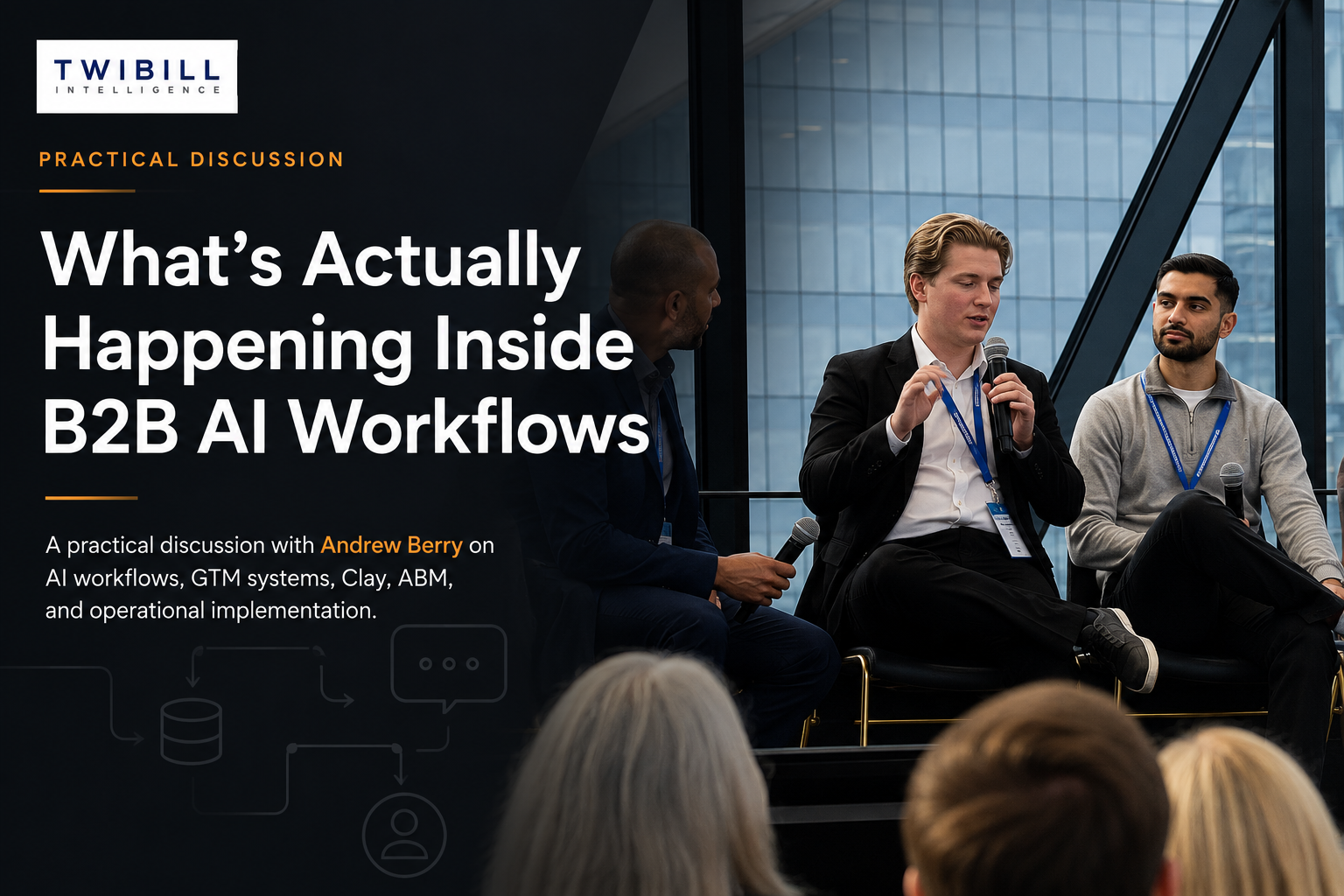
Artificial intelligence has rapidly moved from experimentation into day to day operational use across B2B marketing and revenue teams. However, once organisations move beyond the initial excitement around AI tools, prompts, automation, and demos, a more difficult challenge starts to emerge.
How do these systems actually work operationally inside real commercial environments?
To explore that question, Twibill Intelligence collaborated with Andrew Berry, whose work focuses on GTM systems, account based marketing, martech, AI workflows, and sales and marketing alignment. The overall angle of the discussion was practical and commercially grounded rather than hype driven.
The discussion explores:
what companies are actually trying to improve with AI
where implementation projects begin to break down
where tools like Clay create genuine operational value
what is currently being misunderstood or overhyped
and what separates organisations getting real traction from those remaining stuck in experimentation
Key topics include:
AI workflows
GTM systems
Clay
ABM
workflow orchestration
outbound operations
AI implementation
commercial systems
operational integration
human led AI workflows
1. What are companies actually trying to improve or fix with AI right now inside marketing or revenue teams?
AI is increasingly being integrated into SEO, outbound, enrichment, ABM, workflow automation, and operational productivity across B2B commercial teams.
“The short answer is pretty much everything. AI tools are letting teams pick up the pace on existing tasks and remove the limitations of cross-functional skills like design and coding, which lets people go wild.
For example, many companies are trying to elevate their SEO to create and optimise search terms at scale. Work that would normally take a long time has now been dramatically cut down. That is especially important given the rise of AI as the new-age Google, so implementing GEO has become rapidly important.
Beyond that, I have seen companies start using AI in outbound to find real-time signals and reach the right people at the right time. It fits well with ABM practices but enhances it with a much wider array of first and third-party data sources, giving the sales team the ammunition to reach out with timely, personalised messages.”
2. Once implementation starts, where do things typically begin to break down operationally?
One of the major themes emerging across AI implementation projects is that operational problems often begin after the initial build stage.
“Things tend to break down when people switch off once something is built. The other common failure is blindly building without thinking about the commercial endstate of the tool. It is really easy to build as you go, but you end up with something unruly that becomes a time sink and starts impacting speed and general usability.
In addition to this, without having clear documentation and bringing everyone on the journey things can break down if the builder leaves the business meaning there is knowledge gaps which can be a real problem (especially if something breaks).”
3. A lot of AI tools look impressive in demos. Why do so many struggle in real environments?
One of the recurring themes in AI adoption is the growing gap between impressive demonstrations and real operational implementation.
“AI is only as good as your understanding of the bigger picture. There is no plug-and-play. It has to live and breathe for your business, constantly monitored, updated, and built with an understanding of your exact use case. If you do not understand the blueprint of how these things work, it is difficult to do any of that.”
4. From your experience, where has Clay genuinely created value inside commercial workflows?
Clay is increasingly being used across GTM and ABM environments for enrichment, segmentation, outbound workflows, and CRM integration.
“Clay creates significant value, and the biggest of that comes from ICP and segmentation. Being able to find the right businesses, enrich them with whatever data is relevant to your GTM strategy (which AI can support in finding and scraping), then have it seamlessly pull into your CRM, opens a world of possibilities. From tracking intent through to creating specific advertising buckets based on vertical or job roles.
Beyond finding the businesses themselves, enriching the email addresses of relevant contacts gives your outbound team the ammunition to do what they do best, which is reach out with human messaging.
Clay can be difficult to use without prior training, though. It is a real art. I always say it is a spreadsheet on steroids. Extremely powerful, but if misused, a nightmare to clean up and a credit usage black hole.”
5. Where do you think AI tooling is currently being misunderstood or overestimated?
Much of the current AI conversation still focuses heavily on automation and replacement narratives.
“A lot of people are looking for the easiest path. AI is not a quick win. It needs to be understood and built with care and precision, with a clear grasp of the technical details. Copy-pasting what you see everywhere can be dangerous.
AI credits also cost a lot of money at scale. I do not believe everyone’s jobs are going to be taken and that you will have fully AI-driven departments. The biggest shift is that people who do not embrace this digital gold rush will be left behind, and the people who do will be ahead and therefore more employable.
If you believe AI is going to come in and run your business in an automated fashion, you are mistaken. It is an enabler, not a replacer.”
6. Are companies mostly trying to speed up existing tasks, or are any genuinely redesigning workflows around AI?
A growing number of companies are now moving beyond productivity gains and beginning to redesign workflows around AI.
“Companies are doing both, but the really good ones are using AI to redesign key areas that sit isolated within the business and interconnect them through AI. They use it as an orchestrator, or brain, to create a better connected system.
That said, there is significant value in making small, incremental changes that slowly automate the annoying processes. The compound effect over time is significant.
I always believe that, instead of looking at the art of the possible, you have to think of the art of the universe. Look beyond what is currently possible, think about what would be cool or genuinely useful to build, then reverse engineer it.”
7. What seems to separate companies getting real value from those remaining stuck in pilots or experimentation?
One of the strongest operational patterns emerging across AI adoption is that successful organisations tend to begin with smaller focused use cases before scaling wider.
“It is about thinking small to begin with. Focus on a specific use case and work it through to completion. If you get blinded by the capabilities of what AI can do, you end up spreading yourself too thin.
Companies that fully embrace AI, provide training, and keep it at the forefront of every initiative (asking how can we use AI to be more effective?) will drive real results with it.”
8. Looking ahead, where do you think AI will realistically have the biggest impact inside B2B commercial functions?
AI is already significantly changing the speed and structure of commercial execution across B2B organisations.
“AI is going to have a massive impact on B2B commercial functions. One of the main reasons is speed. What used to take a quarter now gets done in mere weeks.
It is also giving non-technical people the ability to bring creative ideas to life without the barrier of specific coding knowledge.
AI is changing every day, so who knows what else will be available in the future. It is all about keeping up to date and constantly having it at the forefront of the mind.”
Frequently Asked Questions
What are AI workflows in B2B marketing?
AI workflows in B2B marketing are operational processes that integrate AI into activities such as segmentation, outbound prospecting, CRM enrichment, campaign execution, workflow automation, and commercial decision making.
What is Clay used for in GTM and ABM?
Clay is commonly used for enrichment, segmentation, ICP development, outbound preparation, CRM integration, workflow automation, and AI supported GTM operations.
Why do AI workflow projects fail operationally?
Many AI workflow projects fail because businesses focus heavily on tools but fail to redesign workflows, establish operational ownership, document systems properly, or align AI outputs with commercial objectives.
What is workflow orchestration in AI systems?
Workflow orchestration refers to connecting previously isolated systems, processes, and operational tasks together through AI enabled automation and coordination layers.
Is AI replacing B2B marketing teams?
AI is currently acting more as an operational enabler than a full replacement. Most successful organisations are using AI to improve workflow speed, coordination, and decision support rather than removing human commercial functions entirely.
About the Discussion
This discussion was developed by Twibill Intelligence in collaboration with Andrew Berry.
The discussion explores the operational reality of AI adoption inside modern B2B marketing, GTM, ABM, outbound, and commercial workflow environments.