
Machine Legible Marketing: How AI Agents Are Changing Demand Generation for SMEs
Isights | May 12, 2026
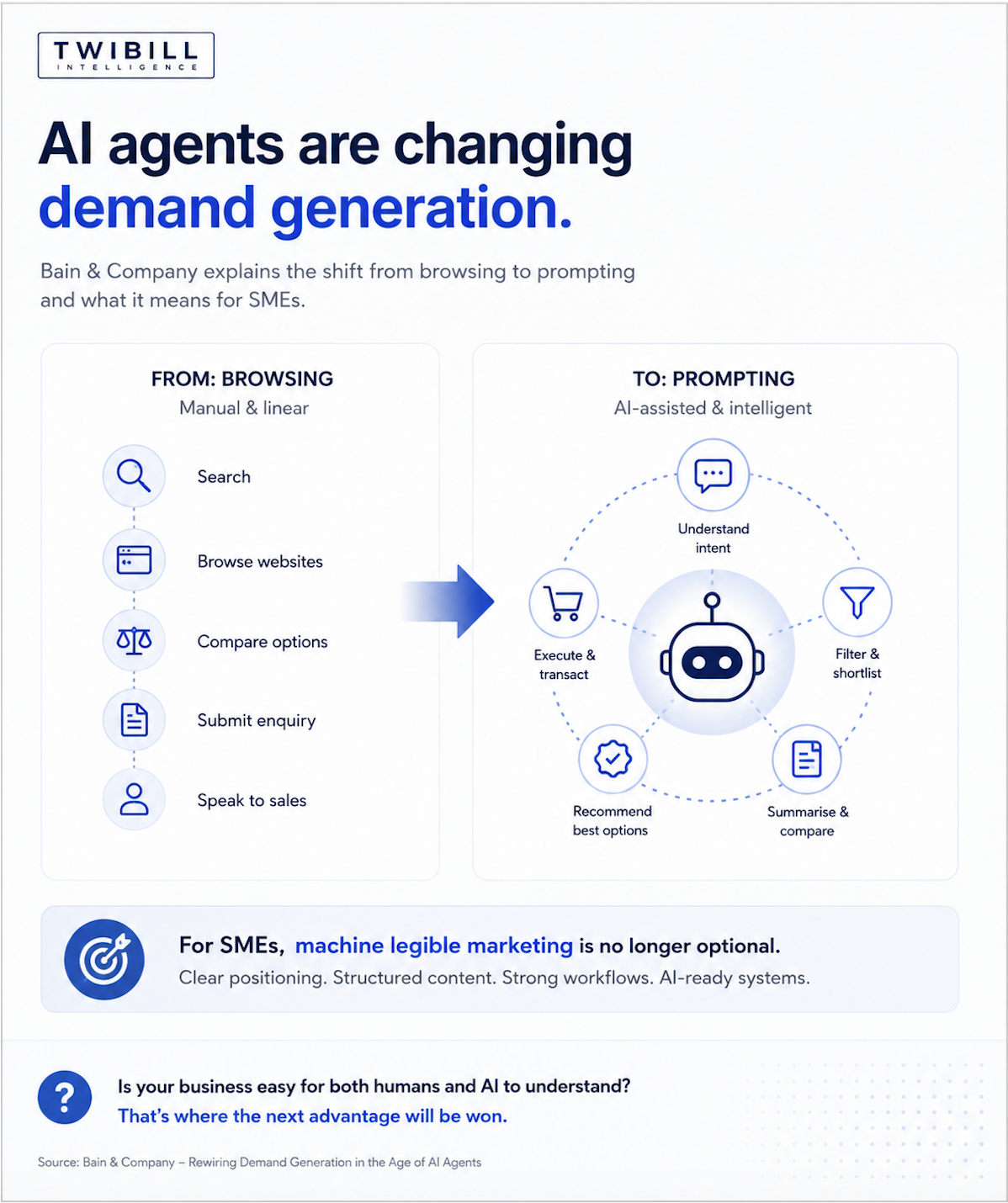
For years, digital demand generation followed a relatively stable pattern. Customers searched online, browsed websites, compared providers, read reviews, downloaded content, submitted enquiries, and eventually spoke with sales teams. Most marketing systems, websites, CRM workflows, and commercial processes were built around this journey.
That structure is now beginning to change.
Large consultancies including Bain & Company, McKinsey & Company, Deloitte, and BCG are increasingly discussing the emergence of AI agents and agentic commerce as a major shift in how buyers discover, evaluate, compare, and purchase products and services online. While much of the early discussion focuses on retail and ecommerce, the broader implications extend well beyond consumer shopping. This is not simply a new digital channel. It represents a wider shift in how demand may be generated, interpreted, and routed across digital environments.
Machine legible marketing refers to structuring a company’s positioning, expertise, workflows, proof points, and commercial information in ways that AI systems can reliably interpret, compare, and recommend. As AI systems become increasingly involved in discovery and evaluation, businesses may need to optimise not only for human buyers, but also for machine interpretation.
According to Bain & Company’s “Rewiring Demand Generation in the Age of AI Agents”, customers are increasingly moving from browsing to prompting, where AI systems interpret intent, compare providers, summarise information, and potentially complete transactions on behalf of users. Bain argues that this shift will reshape not only ecommerce, but also brand building, demand generation, commercial strategy, and operating models more broadly.
For SMEs, this raises an important strategic question: what happens when buyers no longer move through the traditional search, browse, compare, enquire funnel that businesses have spent years optimising around?
Key Concepts
Machine Legible Marketing
Structuring business information so AI systems can interpret, compare, and recommend a company accurately.
GEO
Generative Engine Optimisation focuses on making content easier for AI systems to interpret, summarise, trust, and reference.
AEO
Answer Engine Optimisation focuses on structuring content to answer customer questions clearly and directly.
Agentic Commerce
AI driven systems that assist or automate product discovery, supplier comparison, qualification, and purchasing decisions.
From Search Behaviour to AI Mediated Discovery
Traditionally, digital demand generation depended heavily on visibility. Businesses competed for search rankings, paid traffic, social engagement, website visits, and content engagement in order to attract potential buyers into relatively linear sales and marketing funnels. AI agents change that interaction model because they increasingly sit between the buyer and the business.
Instead of manually reviewing multiple suppliers and websites, buyers may ask AI systems questions such as:
“Find the best CRM for a growing engineering consultancy.”
“Recommend a B2B marketing agency specialising in industrial companies.”
“Compare compliance providers with strong UK and Middle East experience.”
The AI system then interprets intent, filters providers, summarises information, compares options, and potentially recommends a shortlist before a human being has even visited a website.
McKinsey QuantumBlack describes this emerging ecosystem as “agentic commerce”, where AI agents increasingly shape discovery, evaluation, and purchasing decisions. Deloitte has also argued that agentic commerce may become a new digital channel where AI systems interact directly with platforms and retailer systems on behalf of users. BCG has highlighted the speed of movement in this area, with many organisations already experimenting with AI agents and expecting them to handle increasing levels of customer interaction over the coming years.
The broader implication is clear. Businesses may soon need to optimise not only for human buyers, but also for machine interpretation.
Why SMEs May Struggle With AI Discovery
This creates a significant challenge for many SMEs. Large numbers of businesses still operate with vague positioning, fragmented messaging, inconsistent service descriptions, disconnected CRM systems, weak proof points, poor workflow visibility, and inconsistent sales follow up. Human buyers can often navigate this ambiguity through conversations and contextual judgement. AI systems are less forgiving.
AI agents depend on:
structured information
contextual clarity
clear differentiation
validation signals
reviews
accessible expertise
machine readable content
Bain refers to this directly when discussing the need for brands to become both “humanly compelling and machine legible”. That phrase may become increasingly important because visibility may depend less on simply producing more content and more on whether AI systems can accurately interpret, trust, compare, and recommend a business.
GEO, AEO, and the Shift Beyond Traditional SEO
This is where concepts such as GEO and AEO become increasingly relevant. Traditional SEO remains important, but it is no longer the whole picture, GEO, or Generative Engine Optimisation, focuses on structuring content so AI systems can interpret, summarise, and reference it accurately. AEO, or Answer Engine Optimisation, focuses on answering real customer questions clearly, contextually, and directly.
In practice, this means businesses increasingly need:
clearer service explanations
structured expertise
stronger proof points
FAQ driven content
clearer industry positioning
commercially useful information architecture
machine readable content structures
Reply’s GEO guidance also makes this point directly: content increasingly needs to be structured in ways that AI systems can understand, trust, and cite reliably.
This Is Also a Workflow and Commercial Systems Problem
One of the biggest misconceptions around AI driven demand generation is that this is purely a marketing or SEO issue, It is not, it is also a workflow and commercial systems issue. Once AI systems begin influencing discovery and qualification, businesses need commercial workflows capable of responding effectively. That includes:
CRM structure
lead routing
qualification logic
response workflows
proposal processes
reporting visibility
customer data quality
sales and marketing alignment
operational ownership
For many SMEs, the practical challenge is no longer simply adopting AI tools. It is understanding where commercial workflows, customer journeys, decision making processes, and operational systems are slowing responsiveness, creating inconsistency, or preventing AI from being applied effectively.
In practice, many SMEs still operate with fragmented commercial systems underneath relatively modern websites and marketing tools. The result is often:
inconsistent lead handling
duplicated work
disconnected systems
poor visibility into where opportunities are being lost
slow operational response
inconsistent customer experiences
AI does not remove those weaknesses. In many cases, it exposes them more clearly. This is why many AI initiatives struggle operationally even when the technology itself functions well. The challenge is often less about the AI tool itself and more about whether the surrounding workflows, systems, ownership structures, and commercial processes are capable of supporting it effectively.
What SMEs Should Audit First
Most SMEs do not need a complete AI transformation programme tomorrow. However, they should begin assessing whether their commercial systems are becoming AI ready.
A practical starting point is to review:
positioning clarity
service consistency
proof points and reviews
FAQ structure
CRM quality
lead handling workflows
response speed
sales and marketing alignment
workflow visibility
operational ownership
content structure
machine readability
The aim is not simply to deploy more AI tools. The aim is to build clearer, more structured, more responsive commercial systems that are easier for both humans and AI systems to understand and trust.
The Next Phase of Demand Generation
For years, digital competition was largely about visibility. The next phase may increasingly become about interpretability. Businesses will need to communicate clearly not only to customers, but also to the AI systems helping customers make decisions. That does not mean replacing human relationships. It means building commercial systems, workflows, and content structures that are easier to understand, easier to trust, easier to compare, and easier to act on. The companies that adapt earliest may not necessarily produce the most content. They may simply become the easiest businesses for both humans and AI systems to understand.
Frequently Asked Questions
What is machine legible marketing?
Machine legible marketing means structuring a company’s positioning, website content, proof points, service descriptions, reviews, FAQs, and commercial data so that AI systems can accurately understand, compare, and recommend the business.
How are AI agents changing demand generation?
AI agents are changing demand generation by influencing how buyers discover, compare, evaluate, and shortlist companies. Instead of buyers manually browsing multiple websites, AI systems may increasingly interpret their needs and recommend suitable providers directly.
What is GEO?
GEO stands for Generative Engine Optimisation. It focuses on making content easier for AI systems to interpret, summarise, trust, and reference accurately.
What is AEO?
AEO stands for Answer Engine Optimisation. It focuses on structuring content so it answers specific customer questions clearly and directly, making it more useful for search engines, AI assistants, and answer based platforms.
Why does this matter for SMEs?
This matters for SMEs because many smaller businesses have unclear positioning, inconsistent service descriptions, weak proof points, and fragmented sales workflows. If AI systems cannot clearly understand or trust the business, it may become harder for that company to be recommended in AI driven discovery.
What should SMEs audit first?
SMEs should start by auditing their positioning, website structure, service pages, proof points, reviews, FAQs, CRM data, lead handling process, response speed, and sales follow up workflows. The aim is to make the business easier for both human buyers and AI systems to understand.