
The Real Problem with Industrial Inspection Isn’t Automation, It’s Data Flow
Insights April 2026
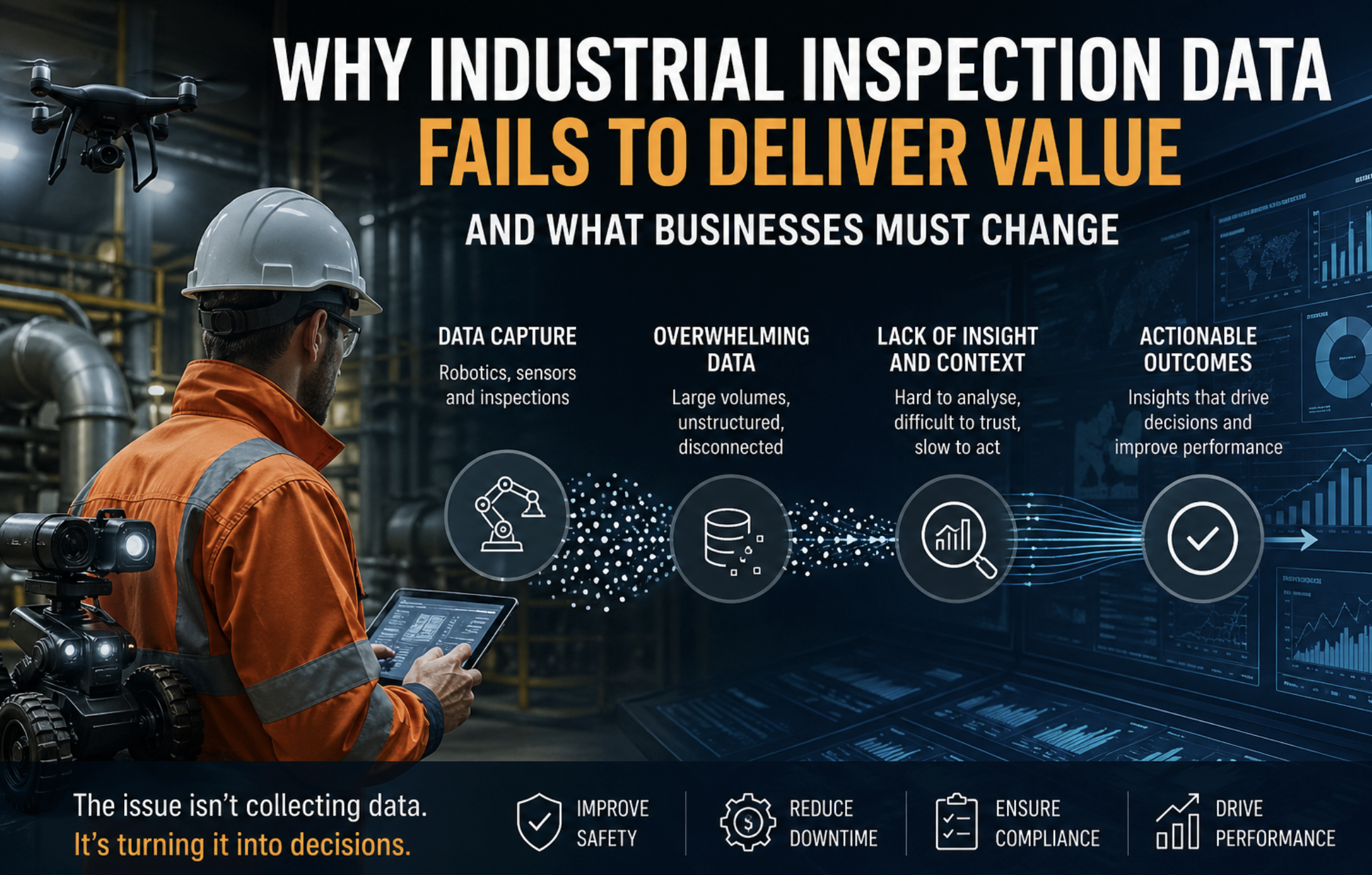
In sectors such as oil and gas, mining, energy, and manufacturing, inspection and quality control activities are fundamental to safe and efficient operations. Many industrial businesses, particularly small and mid-sized operators, are now adopting robotics and digital tools to improve how inspections are carried out.
What has changed is not the need for inspection, but the scale, frequency, and nature of the data now being generated. Driven by robotics, sensors, drones, and automated inspection systems, inspection is shifting from periodic checks to continuous monitoring, from manual recording to automated capture, and from subjective observation to standardised measurement. In industries such as oil and gas, utilities, mining, and manufacturing, this transition is already well underway and is beginning to reshape how operational visibility is achieved.
As inspection capability expands, however, a new constraint is emerging. Organisations are no longer limited by their ability to collect data. They are increasingly constrained by their ability to interpret, structure, and act on the data they already have. This marks a fundamental shift in how inspection should be understood within industrial operations.
Robotics plays a central role in enabling this transition, but its impact is often misunderstood. In practical terms, robotics addresses a physical problem: access. It allows organisations to inspect hazardous, remote, or complex environments that would otherwise require significant human effort, risk, or cost. It also introduces consistency, enabling repeatable inspection routes and standardised measurements across time. In doing so, it increases both the coverage and frequency of inspections while reducing exposure to unsafe conditions.
This is not an incremental improvement. It represents a structural shift in inspection capability, particularly in sectors where safety and reliability are critical. Research highlights the growing role of robotics and AI in improving safety and enabling more efficient inspection and maintenance processes, especially in hazardous environments (Frontiers in Mechanical Engineering, 2025). At a broader level, initiatives such as the UK’s Robotics Adoption Programme position automation as a key driver of productivity and operational improvement across industry (UK Research and Innovation, 2026).
Yet while robotics changes what can be measured, it does not determine how that data is used. Once inspection becomes automated, the nature of the problem shifts from execution to data management and decision-making.
Historically, inspection followed a relatively simple workflow. An asset would be inspected, observations recorded, a report produced, and decisions made based on that report. Although this process was often manual and inconsistent, it was manageable because data volumes were limited and largely human-readable.
In contrast, automated inspection environments generate data continuously across multiple formats, including visual imagery, thermal readings, acoustic signals, gas measurements, and sensor outputs. AI and advanced analytics are already enabling a transition from reactive or scheduled maintenance towards proactive, data-driven models (Frontiers in Mechanical Engineering, 2025). However, more data does not automatically lead to better decisions.
Without structure, data accumulates faster than it can be used. This creates what can be described as the inspection data problem.
For many industrial businesses, increased inspection capability introduces operational friction rather than clarity. Data is captured, but not standardised. Reports are generated, but remain disconnected from operational systems. Findings are identified, but are not consistently tracked or acted upon. Over time, this results in large volumes of information that are difficult to compare, interpret, or translate into action.
The consequences are predictable. Anomalies are missed because there is no consistent baseline. Decisions are delayed because information must be manually interpreted. Data remains underutilised because it is not integrated into workflows. Performance continues to depend on individual expertise rather than system-level intelligence.
This is not primarily a technology problem. It is a problem of workflow design and data structure. The OECD has highlighted that SMEs face persistent barriers in adopting AI effectively, not only due to access to technology but also because of limitations in data quality, digital capability, and organisational readiness (OECD, 2025). In this context, the key issue is not whether organisations have data, but whether they are structured to use it.
The organisations that extract value from modern inspection systems are those that move beyond data capture and focus on data synthesis and workflow integration. Inspection data becomes valuable only when it is captured in a consistent format, structured for comparison, analysed systematically, and embedded into processes that lead to action. This requires aligning data models, analytical tools, and operational workflows into a coherent system.
Evidence from SME robotics adoption supports this view. Research from the Manufacturing Technology Centre and Innovate UK shows that successful implementation depends not just on acquiring technology, but on developing capabilities across integration, operation, and process design (MTC / Innovate UK, 2025). In other words, the effectiveness of robotics and AI is determined less by the tools themselves and more by how they are embedded into the organisation.
Most industrial SMEs are currently operating in a transitional state. Manual inspection processes coexist with digital tools, data may be captured electronically but stored inconsistently, and reporting remains disconnected from operational systems. While new technologies are being adopted, underlying workflows often remain unchanged, limiting their impact.
This is why many organisations experience limited returns from AI and automation initiatives. Without changes to how data is structured and how workflows operate, new tools simply add complexity to existing processes.
The practical path forward is therefore not immediate large-scale automation, but structured workflow design. This begins with defining how inspection data moves through the organisation, from initial capture through to analysis and decision-making. It involves standardising data formats, ensuring consistency across sites and teams, and creating clear connections between inspection outputs and operational actions.
AI can then be applied to synthesise data, identify anomalies, and reduce manual effort in reporting and analysis. Robotics can enhance data capture and expand inspection capability. However, both technologies only deliver meaningful value when they are connected through workflows that translate data into decisions.
This shift is becoming urgent because the gap between data and decision-making is widening. As inspection becomes more automated, organisations generate more data than their existing workflows can handle, increasing the risk of missed anomalies, delayed actions, and operational inefficiencies.
In this environment, inspection is no longer just a field activity. It is becoming a central component of how industrial organisations manage risk, maintain performance, and create value.
Robotics will continue to expand what can be inspected, and AI will continue to expand what can be analysed. The real divide, however, will not be between organisations that adopt these technologies and those that do not. It will be between those that structure their data, design workflows around it, and connect it directly to decision-making, and those that continue to operate with fragmented systems.
The future of inspection is therefore not defined by the transition from manual to automated processes, but by the transition from fragmented data to flowing, integrated systems. The organisations that solve this will not just improve inspection. They will fundamentally change how decisions are made across their operations.
FAQ: Inspection, AI and QC Workflows
Why are industrial SMEs struggling with inspection data?
They are not struggling to collect data, but to structure, analyse, and integrate it into workflows. Without consistency and system integration, data remains fragmented and difficult to use.
How is robotics changing industrial inspection?
Robotics enables more frequent, consistent, and safer inspections, particularly in hazardous or hard-to-access environments. Its main impact is increasing the volume and quality of data available.
What is an AI workflow in inspection?
An AI workflow connects data capture, structuring, analysis, and action. It ensures inspection data is processed, compared over time, and used to trigger decisions such as maintenance or compliance actions.
Why doesn’t more inspection data improve performance?
More data increases complexity if it is not structured and integrated. Without standardisation and automated analysis, organisations struggle to identify patterns and act quickly.
Where should SMEs start with AI in inspection?
Start by defining how inspection data flows through the business. Standardise data capture, ensure consistency, and connect outputs to decisions before introducing advanced AI or robotics.
References
Frontiers in Mechanical Engineering (2025). AI and Robotics in Predictive Maintenance
OECD (2025). AI Adoption by Small and Medium-Sized Enterprises
MTC / Innovate UK (2025). Robot Automation in SME Manufacturing
UK Research and Innovation (2026). Robotics Adoption Programme