
From AI Tools to Workflows: What Leading AI Reports Reveal and What It Means for SMEs
Introduction
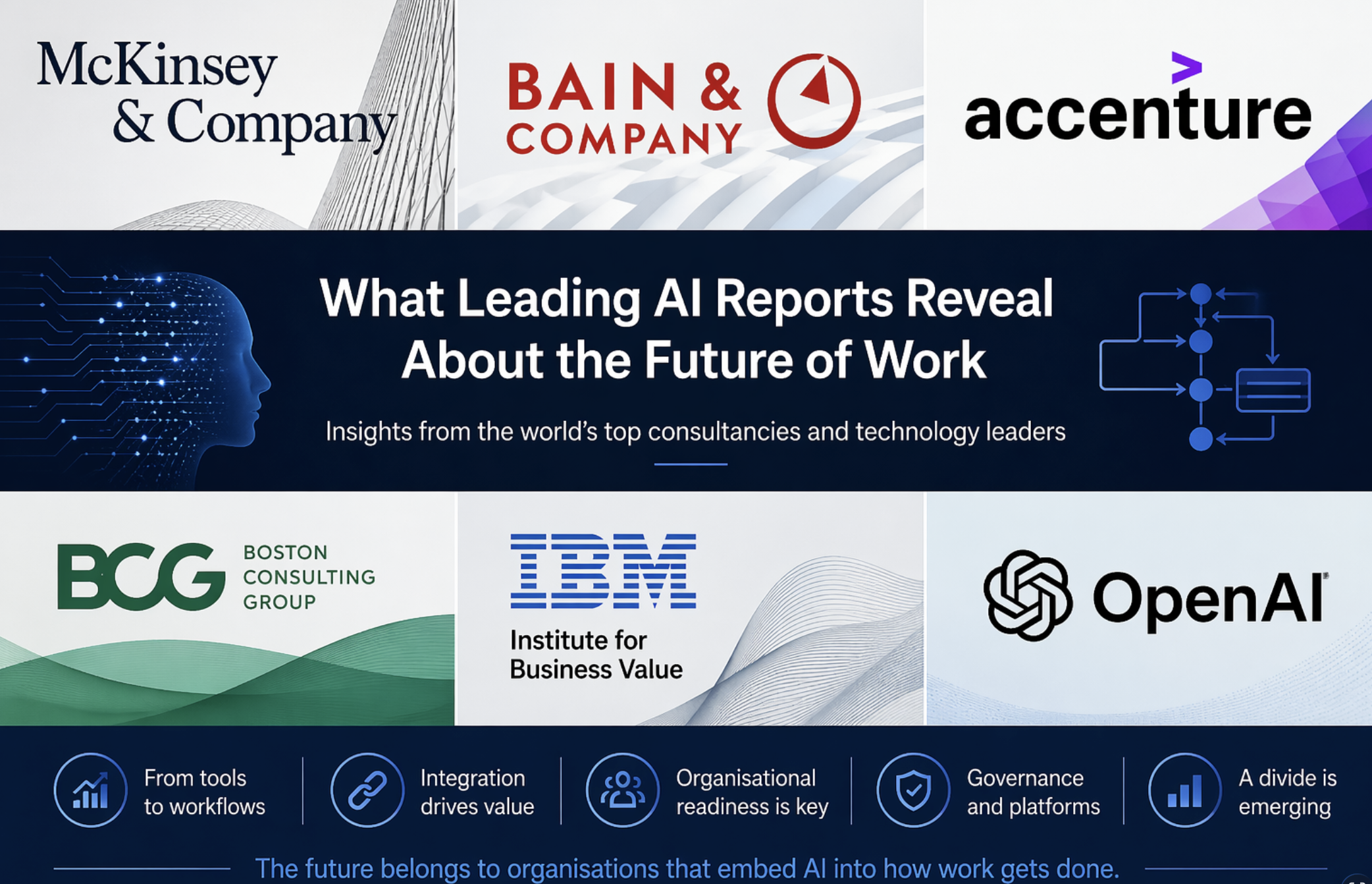
A series of recent reports from organisations including McKinsey, Bain, Accenture, BCG, IBM, and OpenAI point to a clear and consistent shift in how artificial intelligence is being applied within businesses. The emphasis is no longer on isolated use of AI tools. Instead, organisations are moving towards operational systems built on workflows, data, and governance, reshaping how work is structured, executed, and scaled.
As outlined in McKinsey’s analysis of the agentic organisation, this transition reflects a move towards operating models in which AI systems and human teams collaborate across end to end processes rather than discrete tasks. This article synthesises the common themes across these reports and considers their implications in practical terms, particularly for small and medium sized enterprises.
Key insights
AI is transitioning from task based tools to workflow level integration
Sustainable value is derived from integration into systems and processes, not isolated usage
The primary constraint is organisational readiness rather than technological capability
Data quality and governance structures are essential to scaling AI
A structural divide is emerging between shallow and deeply integrated adopters
1. AI is shifting from tools to workflows
Across all reports, a central theme is the transition from using AI to support individual tasks towards embedding AI within structured workflows. McKinsey describes this as the emergence of the “agentic organisation,” where AI participates directly in the execution of processes rather than acting as an auxiliary tool.
This is reinforced by BCG’s perspective on “machines that manage themselves”, which argues that meaningful value is achieved when entire workflows are redesigned around AI, rather than when isolated tasks are automated. Similarly, OpenAI’s enterprise analysis highlights a shift towards multi step usage, where AI is applied across sequences of activities rather than single interactions:
https://openai.com/index/the-state-of-enterprise-ai-2025-report/
Collectively, these findings indicate that AI is becoming embedded within the operational fabric of organisations.
2. Integration matters more than access
A second consistent theme is that access to AI is no longer a differentiating factor. Most organisations now have access to advanced AI tools. However, both Bain and Accenture emphasise that value is realised only when AI is integrated into core systems, data, and workflows.
Across these reports, data is not treated as a supporting layer, but as a core dependency. The effectiveness of AI systems is directly constrained by data quality, accessibility, and structure. Without this foundation, even well designed workflows fail to deliver consistent outcomes.
Bain highlights the importance of building strong foundations for agentic AI, including structured workflows and high quality data environments:
https://www.bain.com/globalassets/noindex/2025/bain_report_technology_report_2025.pdf
Accenture extends this argument by demonstrating that organisations which align AI with platform strategy and enterprise architecture outperform those pursuing disconnected pilots:
In effect, integration, rather than access, is the primary driver of value.
3. The bottleneck is organisational, not technical
Another important point of alignment across the reports is that the principal constraint is no longer technological capability. The technology itself is sufficiently advanced to deliver value. The challenge lies in how organisations are structured to deploy it effectively. IBM emphasises the need for a clearly defined operating model to scale agentic AI, including governance, orchestration, and role clarity:
https://www.ibm.com/thought-leadership/institute-business-value/en-us/report/scale-agentic-ai
Governance emerges as a critical requirement, not just for risk management, but for enabling AI to operate reliably at scale. Without clear ownership, control mechanisms, and oversight structures, agentic systems cannot be trusted to execute core workflows.
BCG further highlights that the introduction of agentic systems requires organisations to rethink decision rights, supervision, and management structures. Accenture similarly identifies platform fragmentation and lack of coordination as key barriers to scaling AI.
Across all sources, the pattern is consistent:
fragmented workflows
unclear ownership
inconsistent processes
insufficient governance
AI does not resolve these issues. It makes them more visible.
4. A divide is emerging between shallow and deep adopters
The reports also point to a growing divergence between organisations that have embedded AI deeply into their operations and those that have not. OpenAI’s data indicates that advanced users apply AI across a wider range of tasks and workflows, achieving greater efficiency and expanded capability:
https://openai.com/index/the-state-of-enterprise-ai-2025-report/
McKinsey similarly observes that while many organisations are experimenting with AI, relatively few have successfully scaled it. This creates a compounding advantage. Organisations that integrate AI into structured workflows continue to improve over time, while those relying on ad hoc usage experience only marginal gains.
5. Implications for SMEs
While much of this analysis is based on large enterprises, the structural implications are arguably more pronounced for SMEs. Large organisations typically have access to dedicated data teams, governance frameworks, and established operating models. SMEs, by contrast, are more likely to encounter:
fragmented tools across functions
informal or inconsistent processes
reliance on individual knowledge rather than structured systems
limited data standardisation and accessibility
minimal governance or oversight structures
As a result, AI adoption within SMEs is often uneven. Tools may be used, but not in a coordinated or repeatable way, limiting their overall impact. Importantly, this is not primarily a question of financial resources. SMEs are not behind because they lack access to AI. They are behind because they lack structured approaches to its use.
The SME opportunity
Despite these challenges, SMEs possess a distinct structural advantage.
They typically operate with:
fewer systems
shorter decision cycles
lower organisational complexity
This creates an opportunity to redesign workflows more quickly and effectively than larger organisations, provided the right foundations are in place. The most effective approach is not broad based adoption, but targeted implementation:
identify a high value workflow
analyse where inefficiencies or inconsistencies exist
introduce AI at specific stages within that workflow
ensure data is accessible and structured to support it
apply basic governance to maintain consistency and control
standardise and repeat
This approach enables SMEs to generate measurable value without the need for large scale transformation programmes.
Conclusion
Taken together, these reports describe a fundamental shift in how organisations operate. AI is not simply an additional tool. It represents a transition towards operational systems built on workflows, data, and governance. The emerging divide is not between organisations that use AI and those that do not. It is between those that integrate AI into structured systems and those that continue to apply it in fragmented ways.
For SMEs, the priority is therefore not experimentation, but structure. AI becomes valuable when it is embedded into how work is actually performed, supported by the data and governance required to make it reliable and scalable.
FAQ
What is agentic AI in simple terms?
Agentic AI refers to AI systems that can execute sequences of tasks within workflows, rather than supporting isolated activities.
Why are most companies not seeing value from AI?
Because AI is often used in isolated ways. Value is created when it is integrated into workflows, systems, data, and processes.
How should SMEs start using AI effectively?
By focusing on a single high value workflow, identifying inefficiencies, and embedding AI into specific steps in a structured and repeatable way.
Is AI adoption mainly a budget issue for SMEs?
No. The primary challenge is organisational structure, data readiness, and process design, not access to technology.