
Why I Proposed a Practical AI Workflow Initiative for SMEs in Collaboration with Cranfield and the Bettany Centre
I proposed this practical AI workflow initiative to help SMEs move beyond tool led experimentation and focus instead on where AI can improve real marketing and commercial workflows.
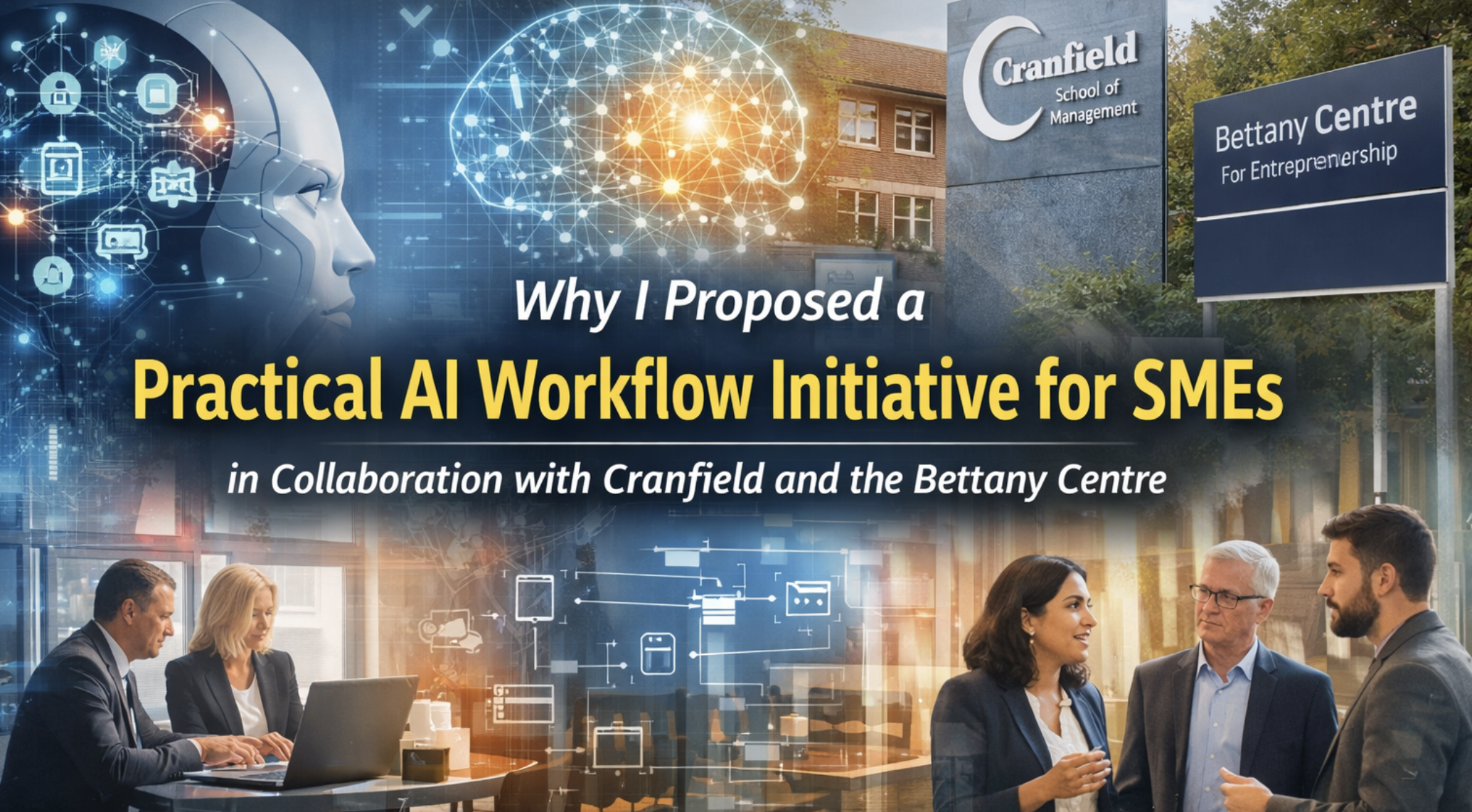
Artificial intelligence is now part of everyday business conversation. Many SMEs are already experimenting with it in some form, whether through content generation, research support, reporting, or ad hoc productivity tasks. But in most cases, the use of AI is still fragmented. Tools are being tested, but not always applied in a way that fits naturally within the way the business actually works. That gap is one of the main reasons I proposed a practical AI workflow initiative for SMEs, now being developed in collaboration with Cranfield and the Bettany Centre.
The thinking behind it was straightforward. Smaller businesses do not usually need more noise around AI. They do not need another wave of generic advice, abstract use cases, or tool-first enthusiasm disconnected from commercial reality. What they need is a clearer understanding of where AI can support the workflows they already rely on day to day, particularly across marketing and commercial activity.
Why I Proposed This Direction
In many SMEs, the issue is not a lack of interest in AI, the issue is that important tasks are still handled in ways that are manual, inconsistent, or overly dependent on individuals. Research may take longer than it should, reporting may be repetitive and uneven and lead follow up may vary depending on who is doing it. Decisions may be made without enough structure, or without useful information being available at the right moment. In that kind of environment, introducing more AI tools does not automatically solve the problem. In some cases, it simply adds another layer of activity without improving how work gets done. A more useful starting point is to look at the workflow itself.
Where is time being lost?
Where is quality inconsistent?
Where does the business rely too heavily on habit rather than process?
Where could better structure improve decision-making, speed, or follow-through?
That is the practical lens behind this initiative.
A Workflow First Approach
The aim is to work with SMEs in a way that starts from real business activity rather than technology in isolation. By speaking directly with businesses, understanding where workflow friction sits, and identifying where AI may be useful, the intention is to move the conversation away from hype and towards application. This is especially relevant across marketing and commercial workflows, where smaller businesses often face a combination of limited time, uneven process discipline, and pressure to make decisions quickly. In these environments, even simple improvements in workflow structure, information access, and consistency can make a meaningful difference.
Rather than asking, “What can AI do?”, the more useful question is often, “Where in this workflow would better support, better structure, or better decision input actually help?”
Why Cranfield and the Bettany Centre Matter
This is also why the collaboration matters. Cranfield brings a strong applied environment and a serious platform for structured thinking. The Bettany Centre adds an important connection to entrepreneurship and SME engagement. Together, that creates a more useful setting for exploring how AI can be applied in smaller business contexts, rather than just discussed in theory. For me, this matters because the challenge facing many SMEs is not access to tools, it is knowing how to apply them in a way that is practical, sustainable, and commercially useful.
What I’m Interested in Building Through This Work
My own interest in this sits at the practical end. I am less interested in AI as a trend in itself, and more interested in how it can support better workflow design, clearer decision making, and more consistent execution in real operating environments.
As this work develops, the focus will be on understanding where AI can be integrated into existing workflows in a way that teams can realistically adopt and sustain. That may involve identifying repeated points of friction, shaping practical tools or methods, and exploring simple ways to improve how work is done rather than adding unnecessary complexity. The broader aim is simple: to help create a more grounded and commercially useful approach to AI for SMEs, one that starts with workflows, real constraints, and practical business needs.
In Simple Terms
This initiative is based on a simple view: Most SMEs do not need more AI hype, they need more practical ways to improve how work gets done. That is the gap I wanted to address by proposing this direction, and why I believe it is worth developing in collaboration with Cranfield and the Bettany Centre.
Related reading
You can also read my earlier article on working with SMEs to apply AI in real business workflows. For more about Cranfield’s entrepreneurship ecosystem, see the Bettany Centre for Entrepreneurship.
FAQ
Why did you propose this initiative?
Because many SMEs are already experimenting with AI, but far fewer have a clear way to apply it within real day-to-day workflows in marketing, sales, and commercial activity.
What makes this initiative practical?
It starts with workflows, not tools. The focus is on understanding how work is actually done, where friction exists, and where AI may support better structure, consistency, and decision-making.
Why work with Cranfield and the Bettany Centre?
They provide a credible and applied environment for engaging with SMEs and exploring practical business challenges in a more structured way.
Is this about AI tools or implementation?
It starts with understanding needs and workflows first. Tools matter, but only if they fit into how the business actually operates.
Who is this relevant for?
It is most relevant for SMEs with active marketing, sales, or commercial processes where time, consistency, and decision quality matter.