
Working with SMEs to Apply AI in Real Business Workflows
In collaboration with Cranfield University.
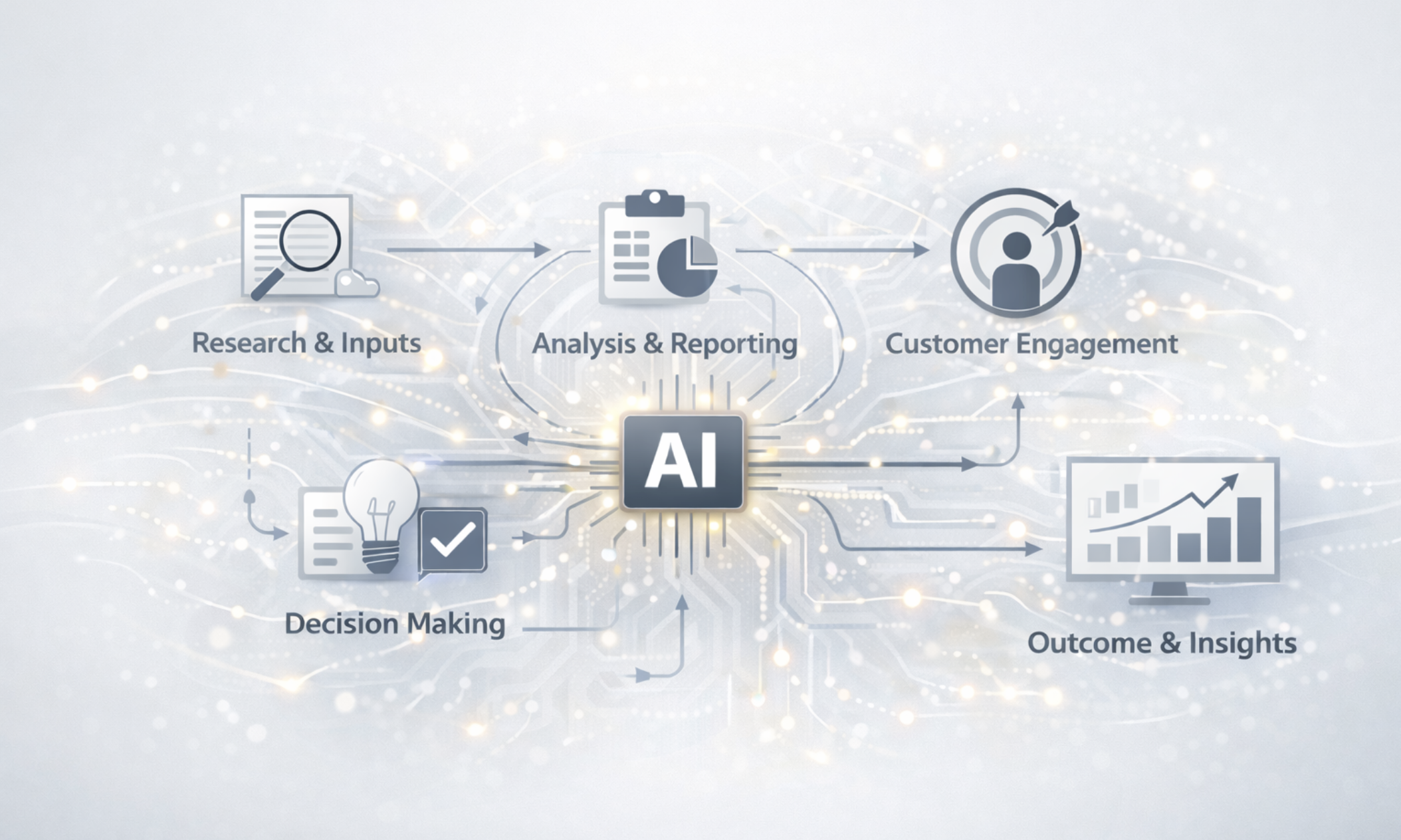
Artificial intelligence is now widely used across SMEs, particularly in marketing, sales, and operational workflows. However, in most cases, its application remains fragmented and inconsistent. Many businesses are experimenting with AI tools, but few have a clear understanding of where AI fits within day-to-day workflows, or how it can be applied in a way that improves efficiency, decision-making, and commercial outcomes.
The real question is no longer whether AI can be used. It is where it actually creates value within the way a business runs. As part of ongoing work with SMEs through a Cranfield linked initiative, the focus is shifting away from tools and towards something more practical: how AI can be applied within real marketing and sales workflows.
What we mean by “AI in business workflows”
In this context, applying AI in business workflows means integrating AI into the steps that teams already follow day to day, such as research, reporting, lead management, and decision making. Rather than using AI as a standalone tool, the focus is on embedding it within existing processes to improve consistency, reduce manual effort, and support better decisions.
The Real Problem
Across different SMEs, a consistent pattern is emerging. Marketing and sales activities are often driven by individuals rather than structured systems. Processes vary depending on who is involved, and outcomes can be inconsistent as a result. Time is frequently spent on repetitive tasks such as research, reporting, and preparation, reducing the time available for higher-value work. Follow-up is another weak point. Leads are generated, but the way they are handled is often unstructured, leading to missed opportunities or inconsistent engagement.
AI is already being used in some of these areas, but typically in isolation. A tool might be used for content, another for analysis, but rarely are these connected into a coherent workflow. This is a common challenge in AI adoption across SMEs, where tools are introduced without being integrated into structured business processes. The issue is not a lack of capability. It is a lack of structure.
What We’re Actually Doing
The work currently underway focuses on applying AI within the context of real business operations, not abstract use cases. This means working directly with SMEs to understand how their marketing and sales processes actually function day to day, where time is lost, and where decisions are made inconsistently.
From there, the focus is on identifying specific points within those workflows where AI can provide support. Not by replacing human input, but by introducing structure, consistency, and better access to information at the right moments. The focus is on practical AI adoption within marketing and sales workflows, rather than isolated use of AI tools. Rather than starting with tools, the starting point is always the workflow itself. This shifts the conversation from “what can AI do?” to “where does it meaningfully improve how work gets done?”
How the Work Is Approached
The approach is deliberately simple and grounded in real business activity. First, existing workflows are reviewed to understand how work is currently done, including where time is spent and where decisions are made.
Next, areas of friction are identified. These are typically points where processes are inconsistent, manual, or dependent on individual judgement. Selected parts of the workflow are then redesigned to incorporate AI in a way that supports, rather than replaces, human input. Simple AI-supported approaches are tested within the business environment, using accessible tools that teams can realistically adopt.
Finally, the focus is on observing how these changes perform in practice. This includes whether they improve consistency, reduce time spent, and support better decision-making.
The Role of Cranfield University
This work is being developed within a Cranfield-linked environment, connecting practical SME engagement with a broader applied research context. Cranfield University is known for its focus on applied learning and close collaboration with industry, particularly through initiatives that bridge academic insight and real-world business challenges.
The involvement of the Bettany Centre for Entrepreneurship provides a structured setting for engaging with SMEs and exploring how emerging technologies are applied in practice. This creates a balance between practical experimentation and structured thinking, which is often missing in typical AI adoption efforts.
What Makes This Different
Much of the current conversation around AI in business is centred on tools, automation, or content generation. This work takes a different approach. The focus is not on tools, but on workflows. Not on automation for its own sake, but on improving how decisions are made. Not on isolated use cases, but on how AI fits into the broader way a business operates.
It also recognises that adoption is as important as capability. A technically advanced solution has little value if it is not used consistently in day-to-day work.
Early Observations
Even at an early stage, a number of patterns are becoming clear. The biggest challenges are structural rather than technical. Most SMEs already have access to the tools they need, but lack a clear way to apply them within their processes.
Consistency is often more valuable than sophistication. Simple, well-integrated approaches tend to outperform more complex solutions that are not embedded into daily workflows. Decision support is frequently more impactful than content generation. Helping teams make better, more consistent decisions often creates more value than increasing output alone. Adoption remains one of the most significant barriers. The success of any AI-supported workflow depends on whether it fits naturally into how teams already operate.
What We’re Looking to Understand
As this work develops, the focus is on building a clearer picture of how AI is applied in real SME environments.
This includes understanding:
where AI delivers measurable value within marketing and sales workflows
which approaches are actually adopted by teams, and which are ignored
how AI can be introduced in a way that is sustainable and controlled
what practical, day-to-day use looks like beyond initial experimentation
The aim is to move towards a more grounded understanding of AI in business, based on real use rather than assumption.
FAQ
What types of SMEs is this relevant for?
This work is most relevant for SMEs with active marketing and sales functions where efficiency, consistency, and decision-making are important.
Is this focused on specific AI tools?
No. The focus is on workflows and processes. Tools are selected based on how well they fit into the way a business operates.
Is this an academic research project?
No. While the work is connected to a Cranfield-linked environment, it is focused on practical application within real businesses.
What does AI adoption in SMEs actually mean?
It means integrating AI into everyday workflows such as research, reporting, and lead management in a way that improves how work is done, rather than using AI tools in isolation.
How is this different from typical AI consulting?
The emphasis is on understanding and improving real workflows first, then applying AI in a way that teams can realistically adopt, rather than starting with tools or predefined solutions.
Closing
This work is ongoing and will continue to evolve through direct engagement with SMEs. Further insights will be shared as practical patterns and outcomes become clearer over time.