
AI Workflows for SMEs: Why Adoption Isn’t the Problem, Execution Is
Insights | April 2026
Summary
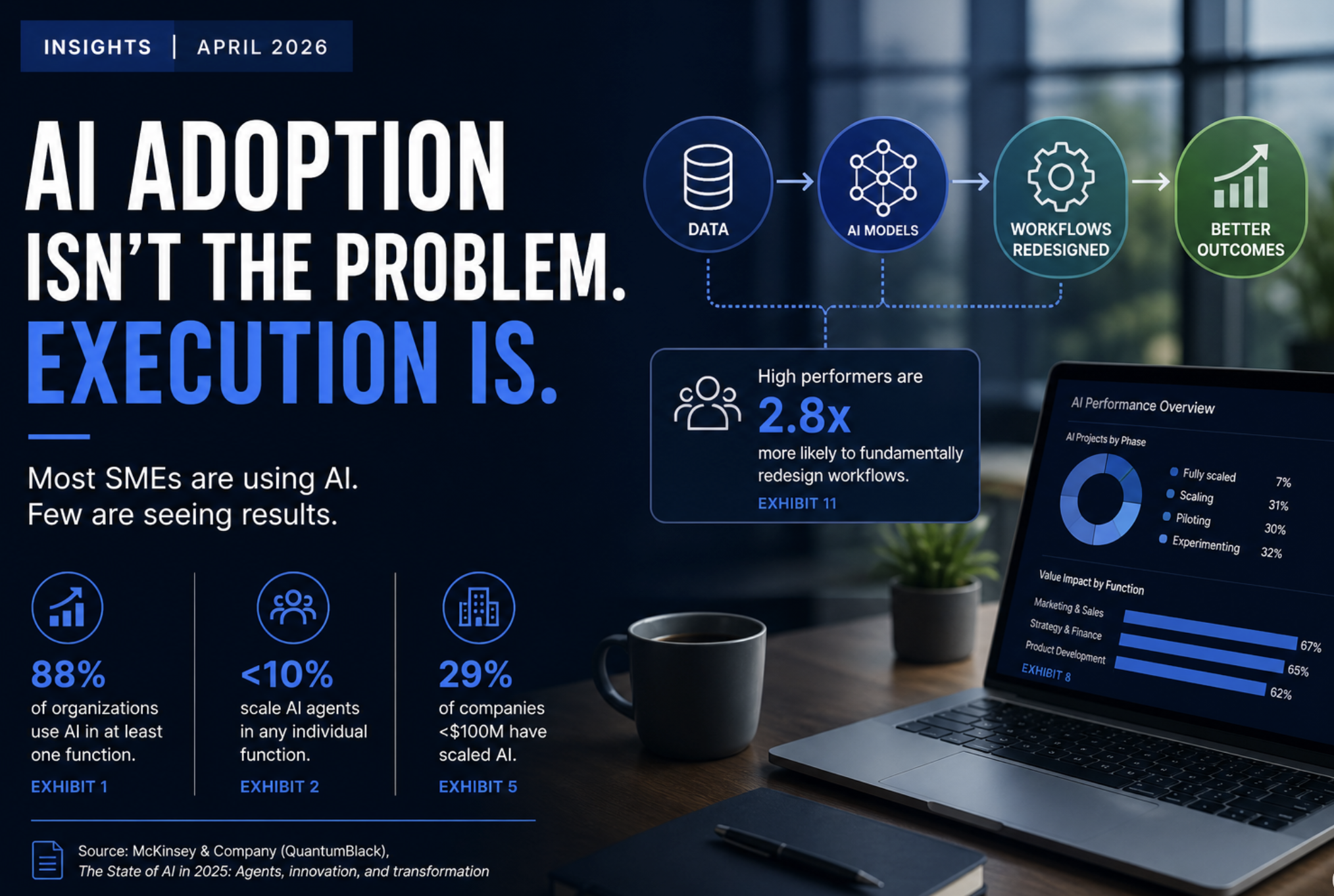
Most SMEs are already using AI, but few are seeing meaningful results. The issue is not adoption, it is execution. High performing organisations redesign workflows around AI, while others layer tools onto existing processes. The difference is not technology, but structure.
Introduction
Artificial intelligence is no longer experimental in most industries. Across sectors, organisations are already using AI in at least one business function, and adoption continues to increase at pace. What was once considered emerging is now part of everyday operations.
This creates a misleading narrative. The assumption is that the primary challenge is adoption, that organisations are still figuring out whether or where to use AI. In reality, that problem has largely been solved.
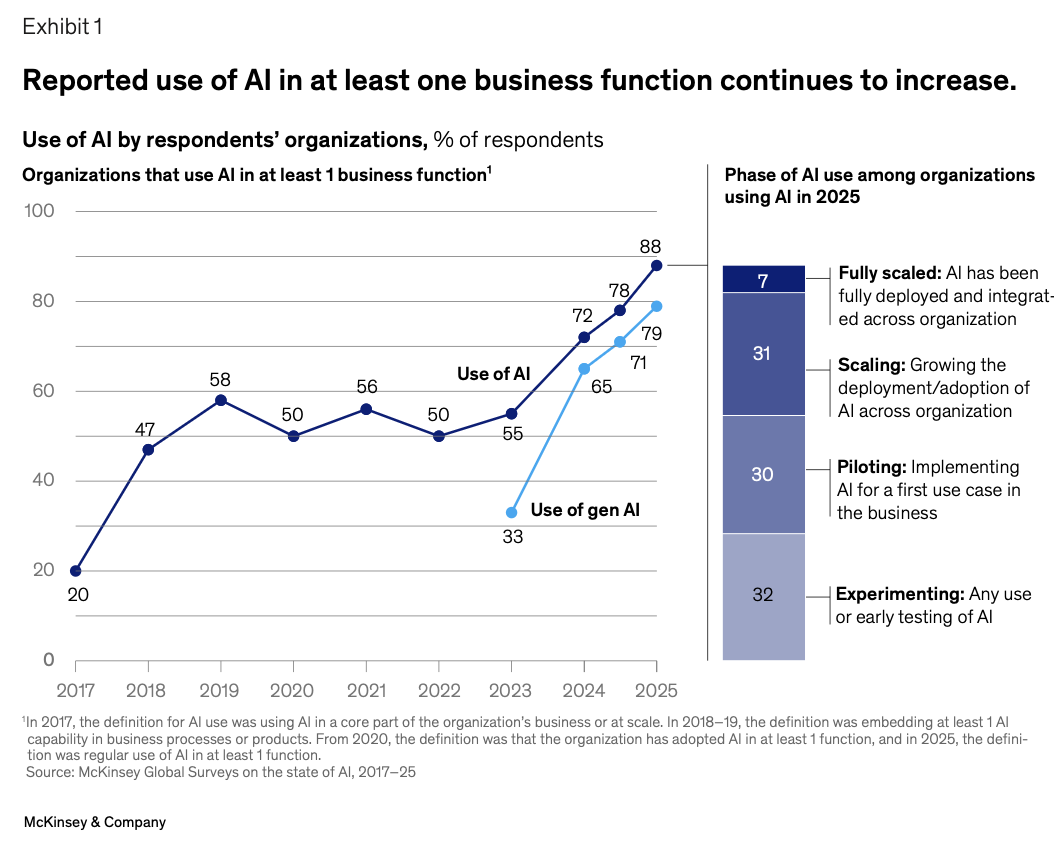
Most organisations are already using AI in some capacity. The constraint is no longer whether companies adopt AI. The constraint is whether they are extracting meaningful value from it.
The scaling problem, not the adoption problem
Despite widespread usage, very few organisations are successfully scaling AI. Across business functions, only a small minority report that AI systems have moved beyond experimentation or pilot phases into full operational deployment.
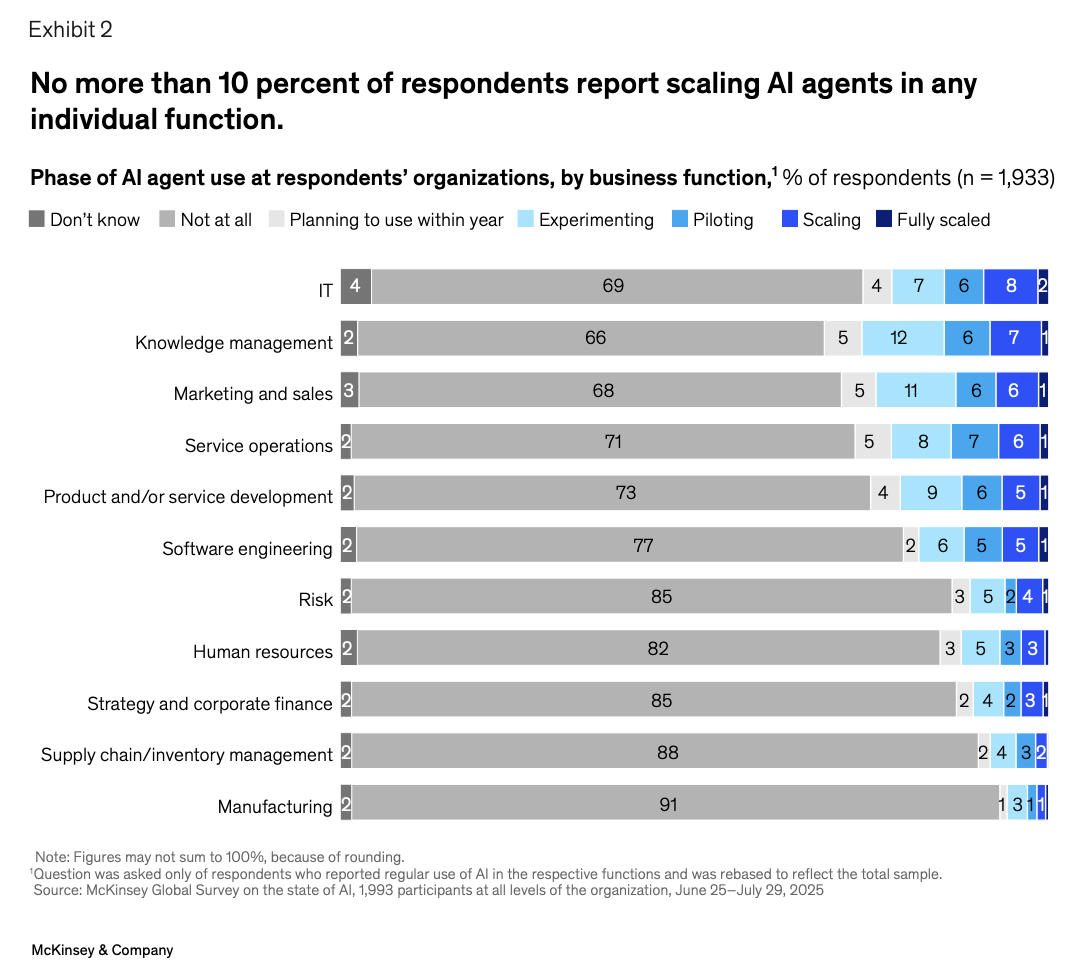
This gap between adoption and scaling is where most value is lost. Organisations are active, but not effective. They are experimenting, but not transforming.
For smaller organisations, this gap is even more pronounced. Companies under $100 million in revenue are significantly less likely to move beyond experimentation compared to larger firms.
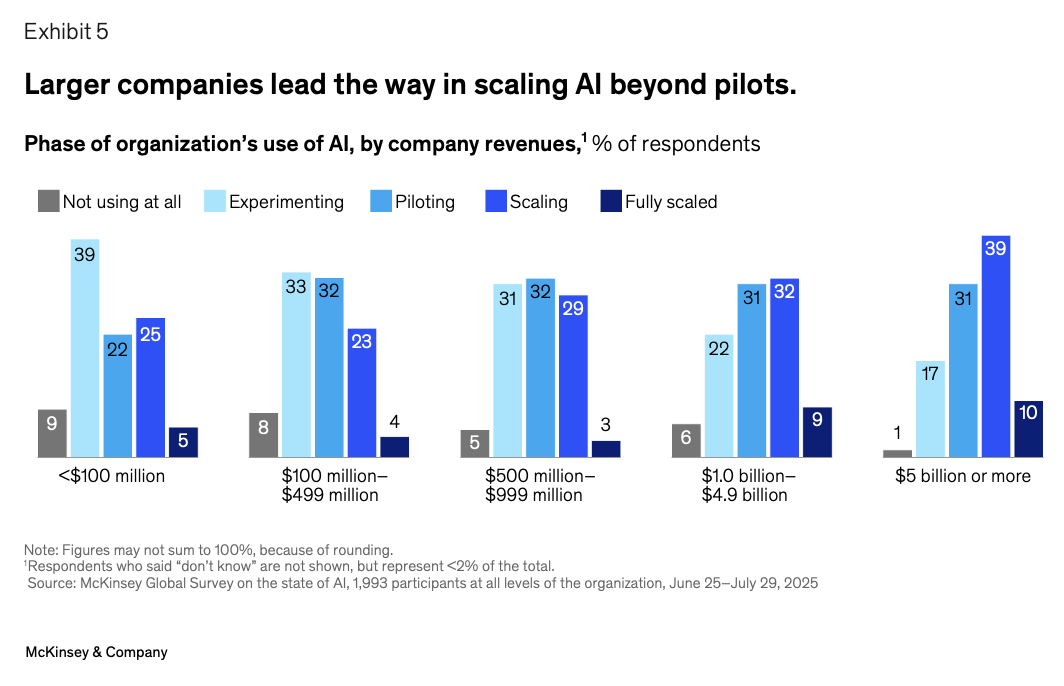
This is not simply a matter of resources. It reflects a structural issue in how AI is being applied inside the business.
AI is everywhere, but not embedded
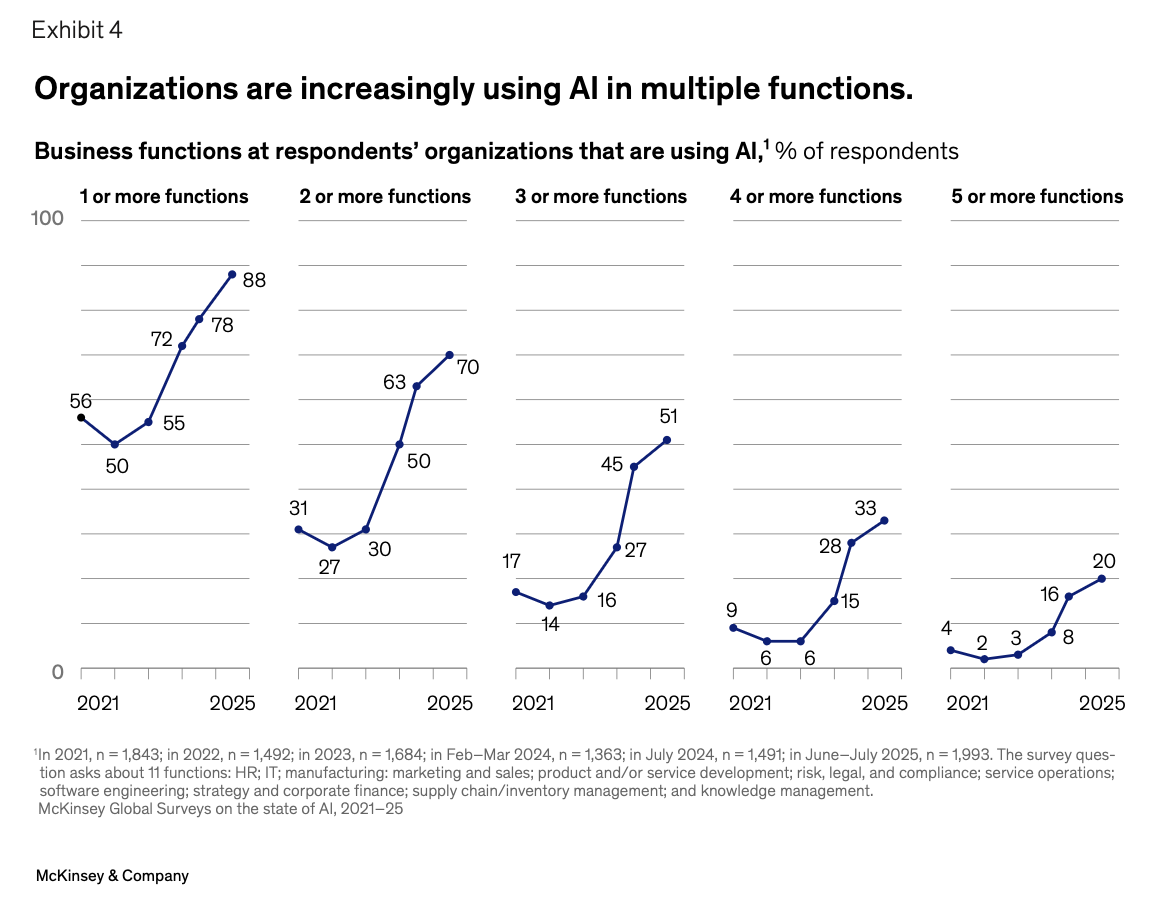
AI is now being applied across marketing and sales, operations, product development, and risk. On the surface, this looks like progress.
In practice, it often leads to fragmentation. AI initiatives are distributed across functions, but not integrated into how the organisation actually operates. Tools are introduced into isolated areas, while the underlying workflows remain unchanged.
As a result, activity increases, but performance does not improve proportionally.
Where AI is actually creating value
When AI does deliver measurable impact, it is not evenly distributed. The strongest effects are seen in areas directly linked to growth, particularly marketing and sales, strategy, and product or service development.
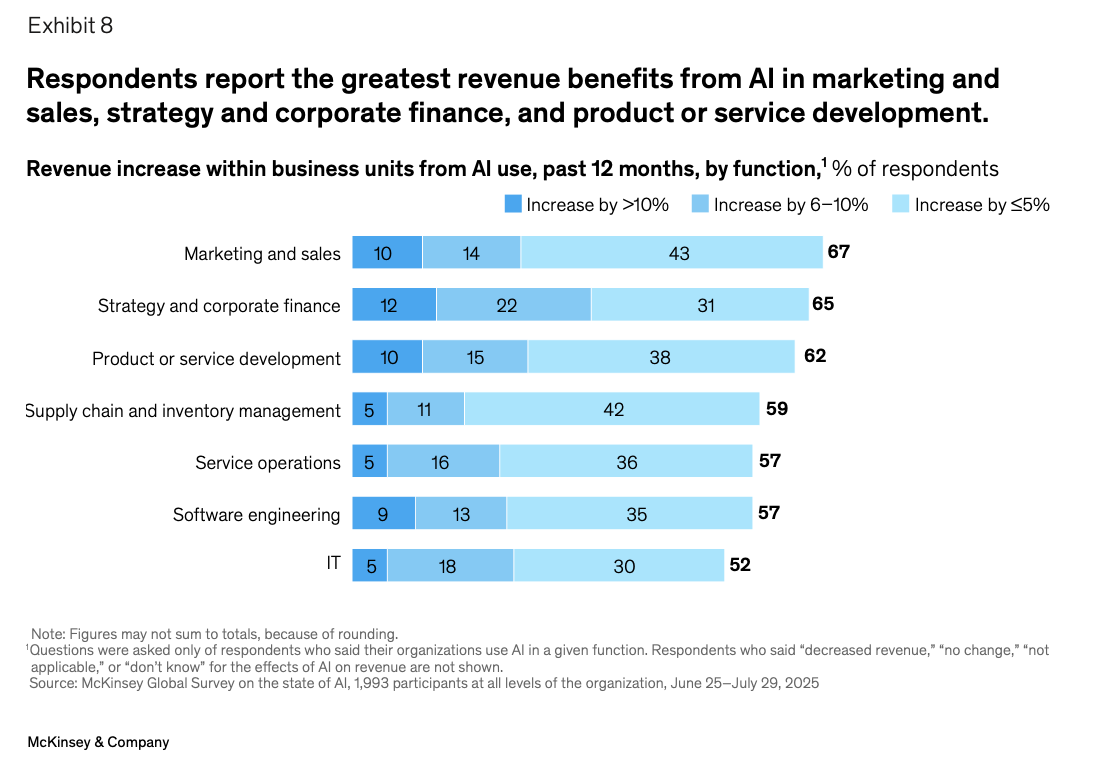
AI creates value when it is integrated into workflows that influence decisions, customer engagement, and revenue. For many SMEs, this is where the disconnect becomes clear. AI exists within the business, but not in the places where it can materially change outcomes.
The real differentiator: workflow redesign
The most important distinction is not about tools or models. It is about how organisations change the way they work.
High performing organisations are nearly three times more likely than others to fundamentally redesign their workflows when deploying AI.
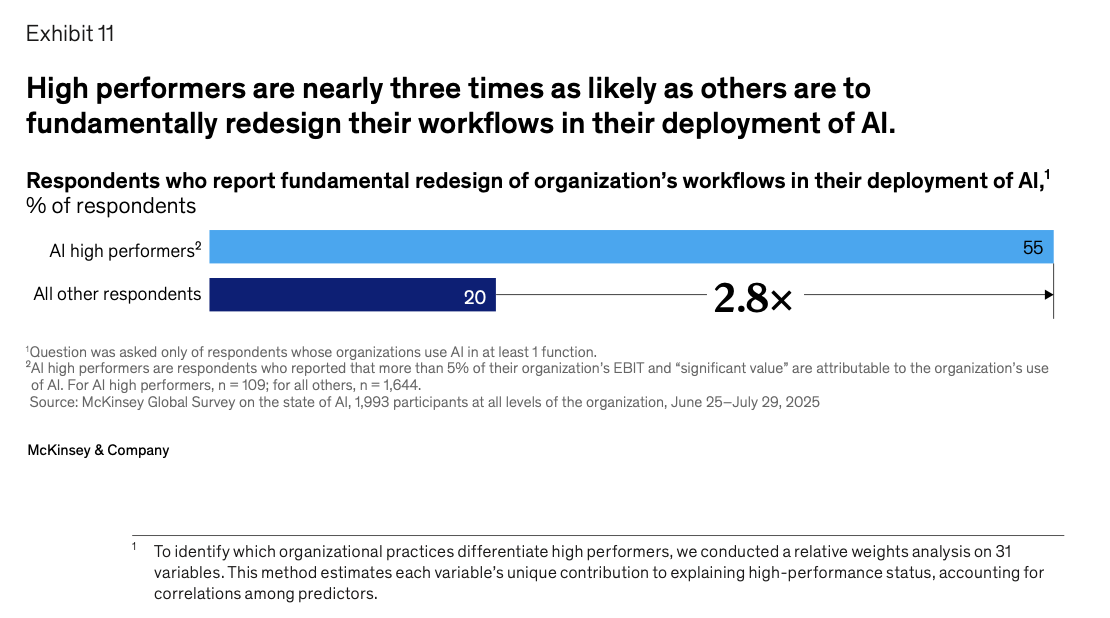
This is the core divide. Organisations that treat AI as an add on see limited results. Those that redesign workflows around AI begin to see meaningful impact.
Workflow redesign means rethinking how work flows across the organisation. It involves redefining how data is structured, how decisions are made, and how actions are triggered. It is not an incremental improvement. It is a structural shift.
From tools to operating models
This difference becomes clearer when looking at how high performing organisations operate. They embed AI into business processes, align it with strategy, and build supporting data systems around it.
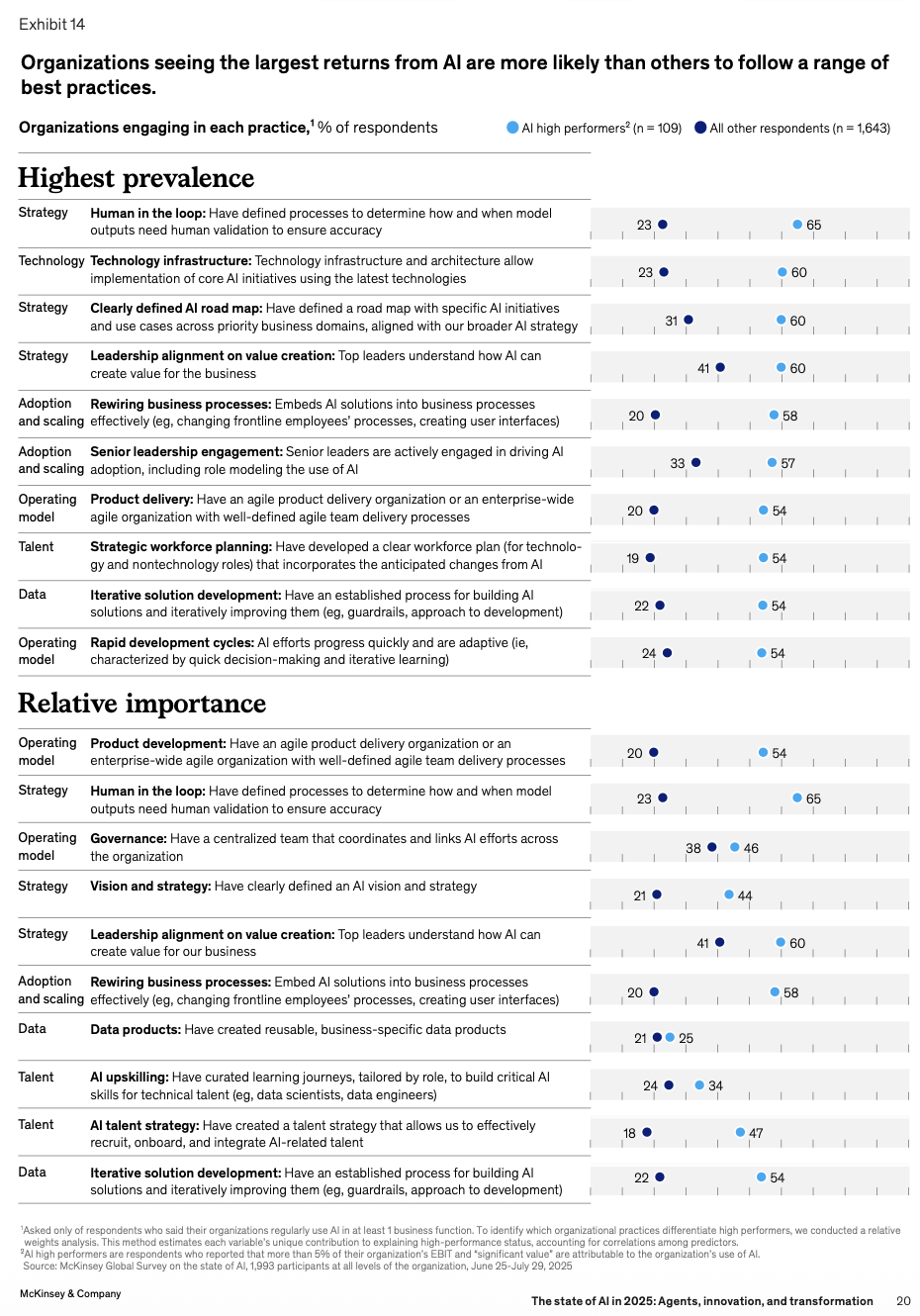
This includes:
redesigning processes to integrate AI outputs
structuring data for reuse and comparison
aligning AI initiatives with strategic priorities
building iterative systems rather than isolated use cases
Lower performing organisations, by contrast, tend to deploy AI in disconnected applications without changing how work is executed.
Scaling is an outcome of structure
This difference directly affects whether organisations are able to scale AI. High performers are significantly more likely to move AI into operational use across multiple functions.
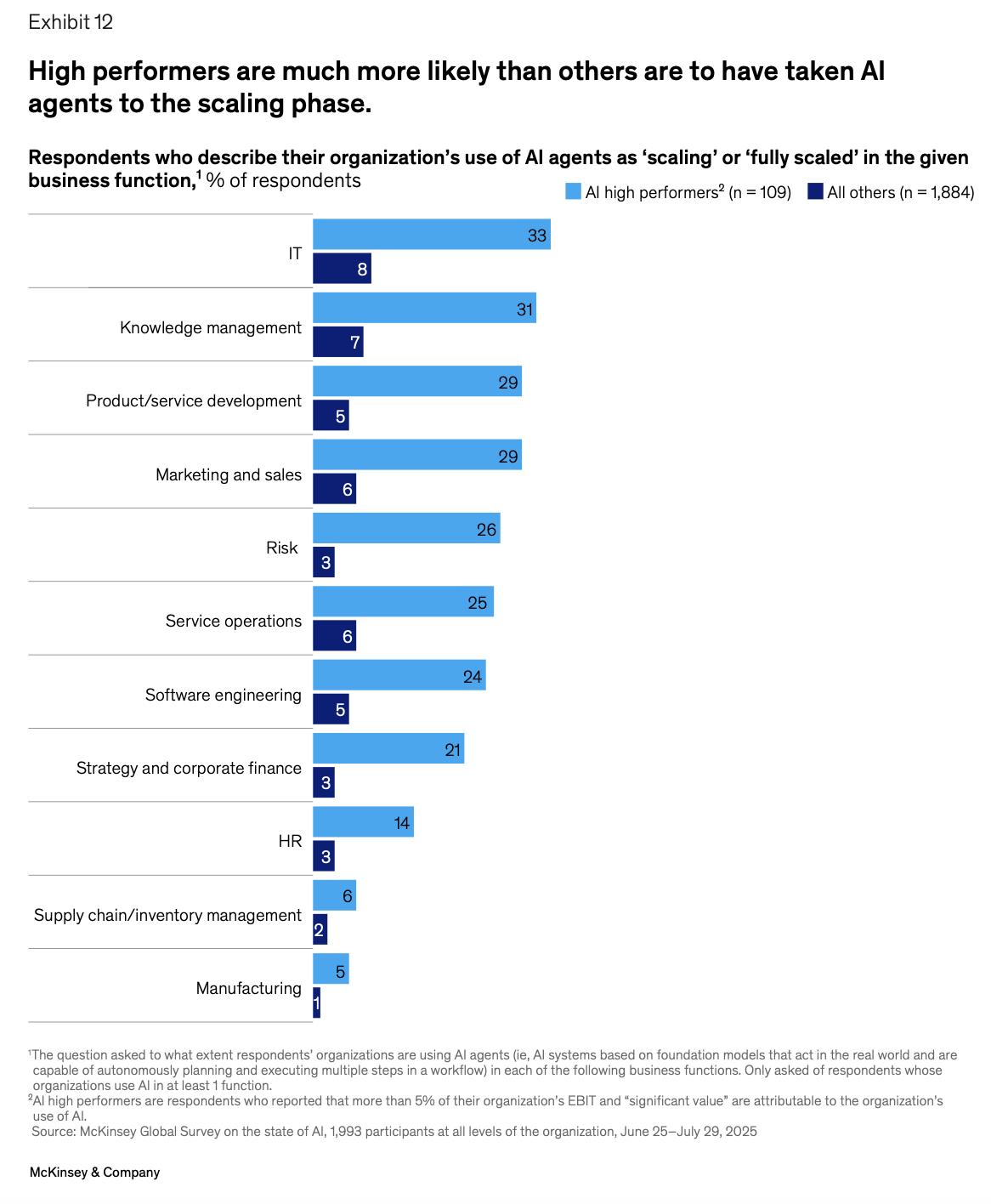
Scaling is not achieved through additional tools or more experimentation. It is the result of having workflows and systems that support consistent execution. Without this, organisations remain in a cycle of pilots.
A different strategic mindset
Another distinction lies in how organisations define the purpose of AI. While many focus primarily on efficiency and cost reduction, high performers are far more likely to link AI to growth and innovation.
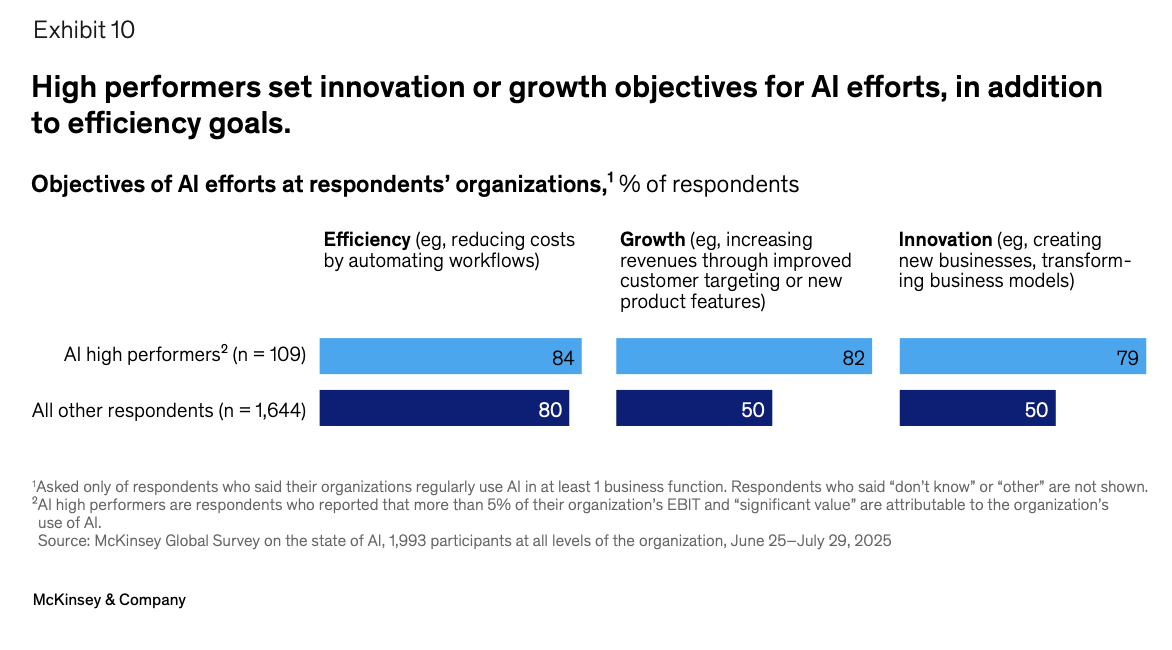
This changes where AI is applied. When tied to growth, it becomes embedded in customer facing and revenue generating workflows. When viewed purely as an efficiency tool, it remains confined to isolated improvements.
For SMEs, this distinction is critical. Limited resources mean AI must be applied where it can directly influence commercial outcomes.
Leadership and ownership
The role of leadership cannot be separated from outcomes. Organisations that generate meaningful impact from AI are far more likely to have senior leaders who actively own and drive these initiatives.
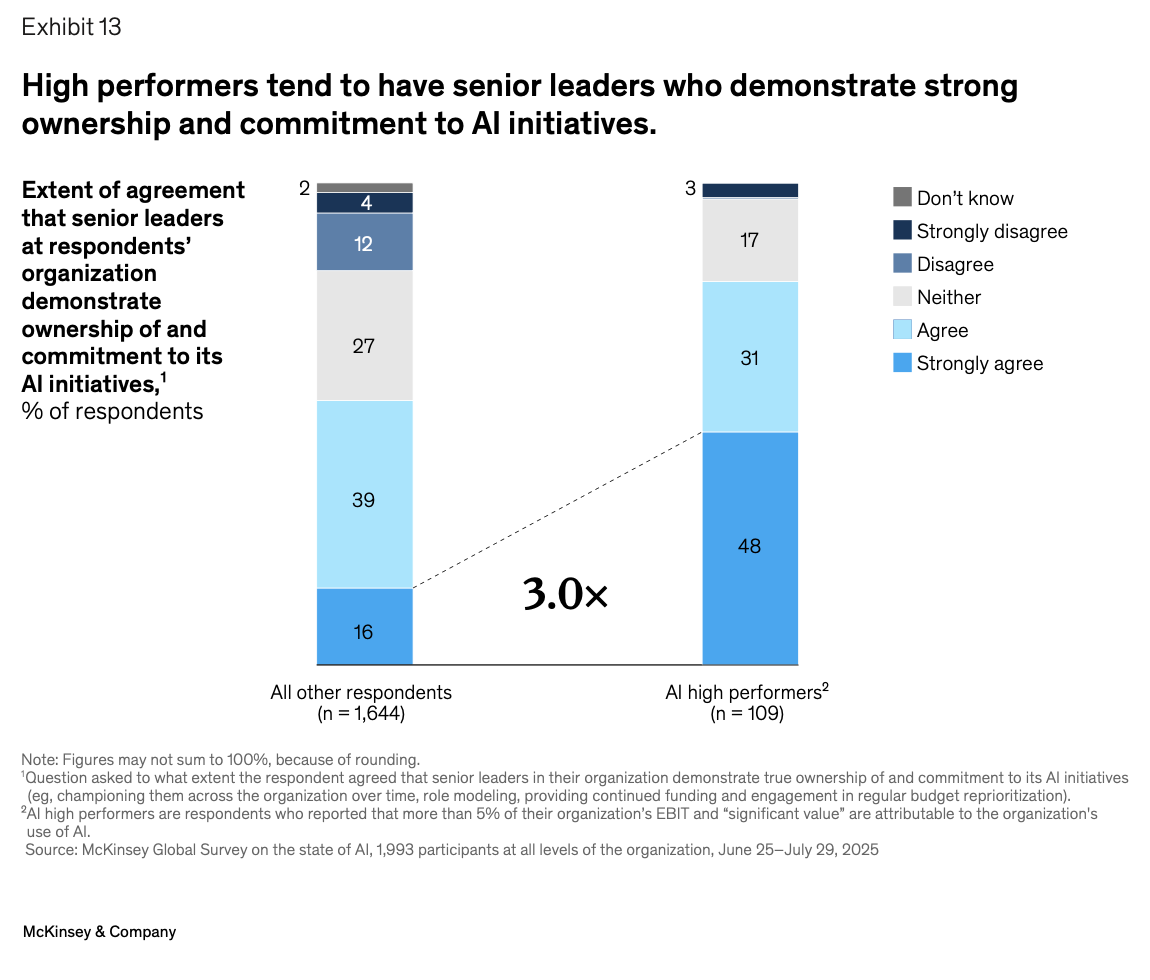
This reflects a clear understanding of how AI creates value and a commitment to aligning teams, processes, and investment accordingly. Without this ownership, AI remains a technical initiative rather than an organisational capability.
What this means for SMEs
For most small and mid sized businesses, the implication is straightforward. The challenge is not access to AI tools. It is not a lack of data. It is not even a lack of use cases, the challenge is that workflows have not been redesigned to incorporate AI in a way that changes how decisions are made and actions are taken. AI is often layered onto existing processes rather than integrated into them. As a result, the organisation continues to operate in the same way, with marginal gains at best.
Conclusion
AI is already present across most organisations. Adoption will continue to increase, and new tools will continue to emerge. The real divide will not be between companies that use AI and those that do not. It will be between those that redesign their workflows to integrate AI into how they operate, and those that continue to layer it onto fragmented systems. For SMEs, this is not a question of technology. It is a question of structure.
Until workflows change, outcomes will not.
Key Questions
Why are SMEs not seeing results from AI?
Because AI is added to existing processes rather than integrated into redesigned workflows that drive decisions and actions.
What is the biggest mistake companies make with AI?
Treating AI as a tool instead of redesigning workflows around it.
Where does AI create the most value?
In revenue linked functions such as marketing and sales, strategy, and product development.
How should SMEs approach AI?
By focusing first on workflow design, data structure, and decision integration before scaling tools.
Reference
QuantumBlack, AI by McKinsey (2025), The State of AI: Agents, Innovation and Transformation; https://www.mckinsey.com/capabilities/quantumblack/our-insights/the-state-of-ai?utm_source=chatgpt.com#/