
How AI Is Bringing Enterprise Capabilities to SMEs
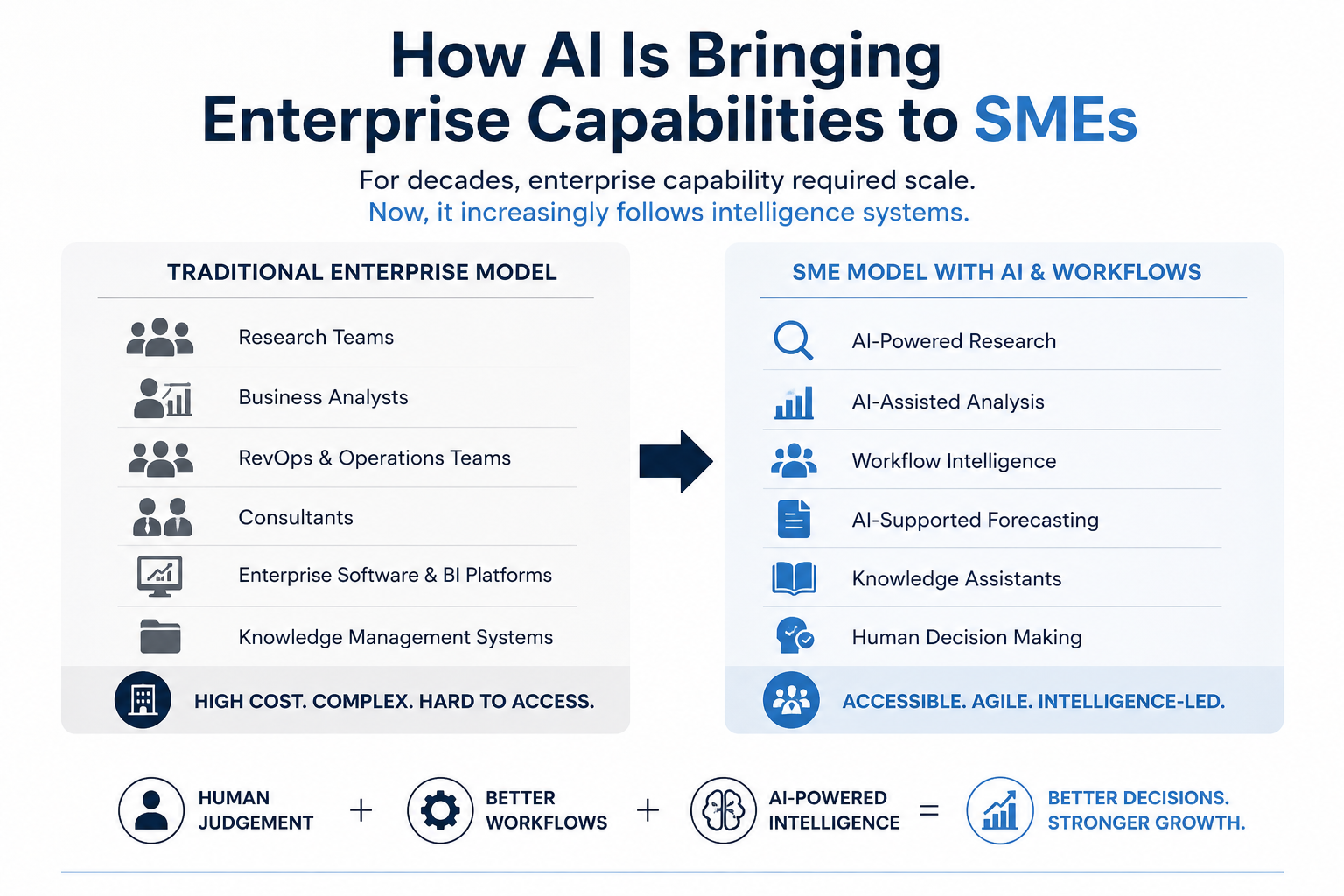
For decades, business capability was closely linked to scale. Large organisations could afford specialist teams, sophisticated software, dedicated analysts, and external consultants. If a company wanted advanced forecasting, market intelligence, business process optimisation, or detailed reporting, it typically needed significant investment in people, systems, and expertise.
Smaller businesses faced a very different reality. Founders often acted as strategists, sales leaders, marketers, and operations managers simultaneously. Reporting was frequently manual, customer knowledge sat inside individual inboxes, and market research was conducted whenever time allowed rather than through a structured process. The challenge was rarely ambition or vision. More often, it was a lack of access to the capabilities that larger organisations took for granted.
This imbalance created a structural advantage for larger enterprises. Better information led to better decisions. Better coordination led to more consistent execution. Better execution often translated into stronger commercial performance. For many years, capability followed budget. Today, that relationship is beginning to change.
The reason is not that AI is replacing people or making enterprise software obsolete. The more significant shift is that AI is reducing the cost of accessing capabilities that were previously available only to organisations with greater resources. For the first time, many SMEs can begin to access forms of intelligence, analysis, coordination, and operational support that once required substantial investment.
This is why the current wave of AI adoption deserves more attention than the typical conversation about productivity gains and automation. The real story is not that businesses can write content faster or automate administrative tasks. The real story is that AI is beginning to democratise business capability.
The Shift From Productivity to Capability
Much of the discussion surrounding AI focuses on efficiency. Businesses are encouraged to automate repetitive tasks, generate content more quickly, and reduce the amount of time spent on routine activities. These benefits are certainly valuable, particularly for smaller organisations with limited resources.
However, focusing exclusively on productivity risks missing the larger strategic shift taking place beneath the surface.
Historically, many business capabilities required dedicated functions. Market intelligence required researchers. Forecasting required analysts. Process improvement often required consultants. Knowledge management depended on enterprise platforms and significant administrative effort. Each capability came with associated costs, which meant that access was often determined by organisational size.
AI is beginning to alter this equation. Research that previously took days can now be completed in hours. Large volumes of information can be analysed more efficiently. Knowledge can be surfaced from multiple sources almost instantly. Reporting processes can be accelerated, and patterns can be identified earlier than before.
Importantly, this does not eliminate the need for expertise. Rather, it changes how expertise is accessed and applied. A smaller organisation can now leverage tools and workflows that support activities previously reserved for larger teams.
Research from leading organisations such as McKinsey has consistently highlighted that the greatest value from AI comes not from isolated tools, but from redesigning workflows and operating models around them. In other words, the technology itself creates potential, but the surrounding business processes determine whether that potential becomes commercial value.
Why This Matters for Commercial Teams
The implications become particularly interesting when viewed through the lens of sales, marketing, and commercial operations.
Many growing businesses experience similar challenges. Marketing teams generate enquiries, but sales teams struggle to follow up consistently. Customer conversations are spread across email threads, CRM systems, and personal notes. Forecasting relies on spreadsheets that quickly become outdated. Proposal creation is time consuming, and market research is conducted intermittently because nobody has enough time to do it properly.
These issues are not uncommon. In fact, they are often symptoms of a business that has grown faster than its internal systems and processes.
Historically, solving these problems usually required additional headcount. A company might hire a sales operations specialist to improve forecasting, a marketing analyst to gather insights, or an external consultant to redesign processes. Larger organisations could absorb these costs relatively easily. Smaller organisations often could not.
AI is beginning to change this dynamic.
Activities such as market research, lead qualification support, proposal drafting, customer insight analysis, workflow documentation, and knowledge retrieval can increasingly be supported through AI assisted systems. The capability itself remains valuable, but the barrier to accessing it is becoming significantly lower.
Consider a simple example. A founder preparing for a new market expansion previously might have commissioned external research, waited several weeks for the findings, and paid a substantial fee. Today, AI can help gather, organise, summarise, and compare information in a fraction of the time. Human judgement remains essential to interpret the findings and make decisions, but the process of reaching those insights becomes dramatically more accessible.
This pattern is repeating across many commercial functions.
The result is not that SMEs suddenly become large enterprises. Rather, they gain access to capabilities that allow them to compete more effectively while retaining the agility that often makes them successful in the first place.
Why Most Businesses Are Still Getting It Wrong
Despite the potential, many organisations are approaching AI in a way that limits the value they receive.
The common pattern is easy to recognise. A business purchases several AI tools, experiments with content generation, automates a handful of administrative tasks, and then wonders why overall performance has not changed significantly.
The problem is that capability does not emerge from tools alone.
A company can have access to the latest AI platforms and still struggle with poor lead management, fragmented customer information, inconsistent reporting, weak forecasting, and slow decision making. Marketing can continue generating leads that are never followed up. Customer knowledge can remain trapped in individual inboxes. Teams can continue duplicating effort because nobody has visibility into what others are doing.
In these situations, technology is rarely the primary constraint.
The underlying issue is usually workflow design. This is a theme we explored in our article “Most Businesses Already Have AI. Now They Need Better Workflows”, where we argued that many organisations have already adopted AI tools but have not redesigned the underlying processes those tools support. As a result, productivity may improve in isolated areas while overall commercial performance remains largely unchanged.
An AI tool may identify a high quality sales opportunity, but a workflow determines whether somebody acts on it. AI may generate valuable customer insights, but a workflow determines whether those insights influence decision making. AI may summarise market intelligence, but a workflow determines whether the organisation responds to what it has learned.
This distinction is important because it shifts attention away from technology acquisition and towards operational design. The organisations generating the greatest value from AI are often not those with the most tools. They are the organisations that have designed effective systems for turning information into action.
Human Judgement Remains the Competitive Advantage
One of the more persistent misconceptions surrounding AI is that it will replace large portions of commercial work. In reality, most businesses face the opposite challenge. They are not suffering from a lack of information. They are suffering from an excess of information and a shortage of clarity.
Leaders still need to prioritise. Sales teams still need to build trust and relationships. Marketing teams still need to understand customer motivations. Managers still need to balance competing priorities and make difficult decisions.
AI can assist with analysis, preparation, summarisation, and research. It can help businesses think faster and access information more effectively. What it cannot do is decide what matters most to a particular organisation in a particular situation.
That responsibility remains firmly human.
The most successful businesses are therefore unlikely to be those that pursue full automation. Instead, they will be those that combine AI supported intelligence with human judgement, oversight, and accountability. Technology will support decision making, but people will continue to direct it.
At Twibill Intelligence, we describe this approach as Human Led Intelligence Systems for Revenue Growth. The principle is simple: AI should support research, analysis, coordination, and execution, while people remain responsible for prioritisation, judgement, and decision making.
What SME Leaders Should Do Next
For leaders considering how AI fits into their organisation, a useful starting point is not identifying the next tool to purchase. A more valuable exercise is understanding where capability is currently constrained.
Where does information get stuck? Where are decisions delayed? Which processes depend too heavily on one individual? Where are teams duplicating effort? Which customer interactions suffer because knowledge is fragmented across multiple systems?
These questions often reveal more opportunity than any software demonstration.
The businesses most likely to benefit from AI over the coming years will not necessarily be those with the largest budgets or the most sophisticated technology stacks. They will be the organisations that use AI to strengthen decision making, improve coordination, accelerate learning, and support more effective execution.
For decades, enterprise capability followed enterprise scale. AI is beginning to weaken that relationship. Not by eliminating the need for expertise, judgement, or leadership, but by making sophisticated capabilities more accessible than ever before.
The opportunity for SMEs is not to become large enterprises. It is to gain access to many of the same capabilities while preserving the speed, flexibility, and entrepreneurial mindset that made them successful in the first place.
Ultimately, the competitive advantage will not belong to the businesses with the most AI tools. It will belong to the businesses that build the most effective intelligence systems around the people who use them.
Frequently Asked Questions
Can AI replace ERP systems?
No. ERP systems remain important for managing operational data and business processes. However, AI can increasingly sit alongside existing systems to improve reporting, forecasting, knowledge access, and decision support.
What enterprise capabilities can AI support?
AI can support market research, lead qualification, reporting, forecasting, proposal development, customer insight analysis, workflow documentation, and knowledge management.
Where should SMEs start with AI?
Most businesses should start by identifying workflow bottlenecks rather than purchasing additional tools. Understanding where information, decisions, and execution break down often reveals the highest value opportunities.
Sources
McKinsey – The State of AI
https://www.mckinsey.com/capabilities/quantumblack/our-insights/the-state-of-ai
Microsoft Work Trend Index
https://www.microsoft.com/en-us/worklab/work-trend-index
Deloitte State of Generative AI
https://www2.deloitte.com
Accenture Technology Vision
https://www.accenture.com/us-en/insights/technology/technology-trends