
The Messy Middle: Why SMEs Are Caught Between Spreadsheets, CRM and AI
Artificial intelligence dominates today’s business conversation.
Every week seems to bring another tool, another announcement or another prediction about how AI will transform the way organisations operate. Vendors promise productivity gains. Consultants promise competitive advantage. Business leaders worry about being left behind.
Yet inside many SMEs, the reality looks very different.
Spreadsheets still drive critical decisions. Customer information remains scattered across inboxes, CRM systems and individual employees’ heads. Sales teams continue to rely heavily on relationships and experience. Marketing teams experiment with automation and AI while trying to make sense of fragmented data and disconnected systems.
Far from entering a new AI powered future, many organisations find themselves caught between multiple generations of working practices. They are operating in what we call the Messy Middle.
This is the uncomfortable space where traditional processes, digital systems and emerging AI capabilities coexist. Businesses have access to more technology than ever before, yet many continue to struggle with visibility, alignment and execution.
Key Takeaways
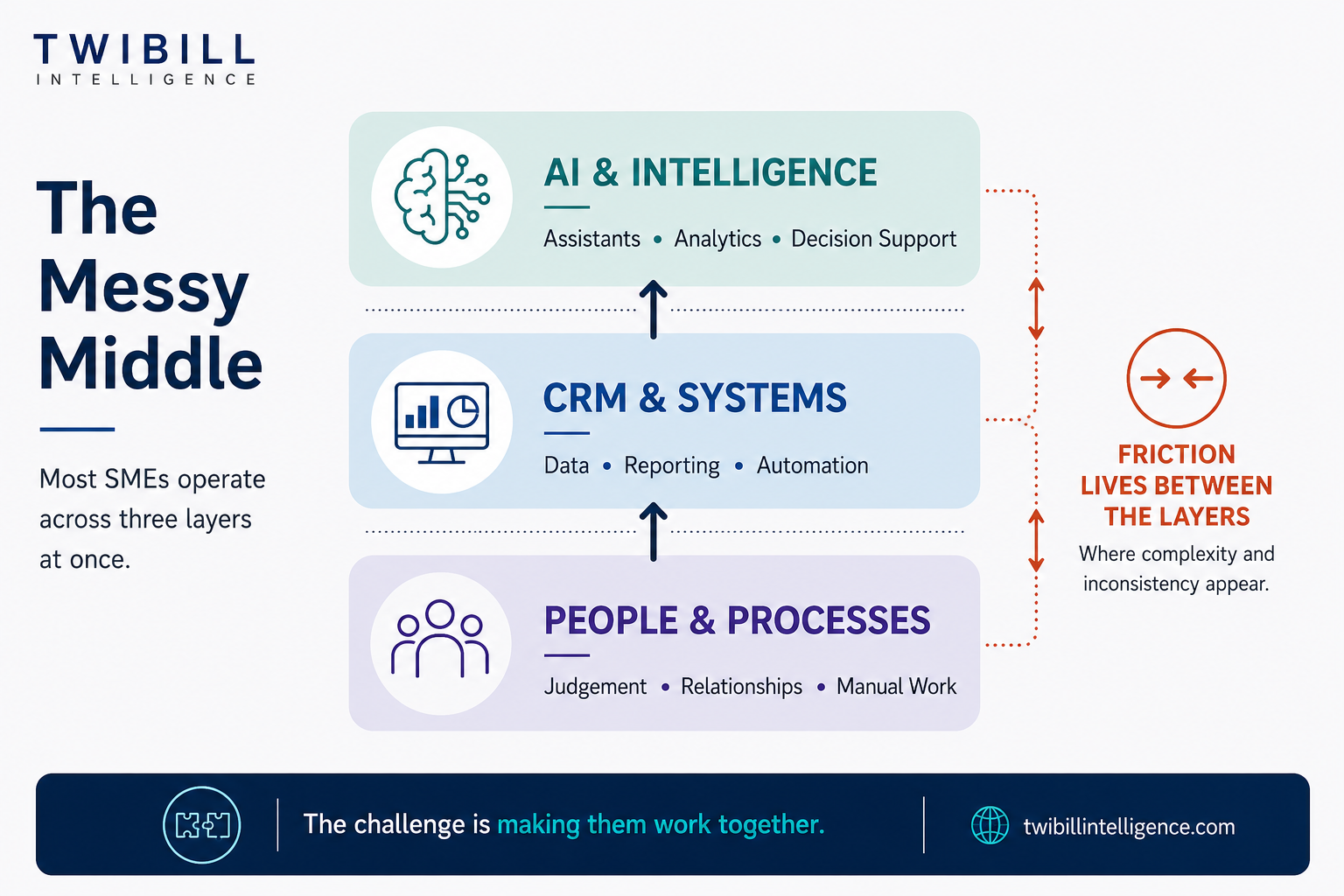
Many SMEs are operating across three layers simultaneously: human processes, digital systems and AI driven intelligence.
AI often exposes workflow weaknesses rather than solving them.
Most commercial challenges stem from fragmented processes, inconsistent data and disconnected systems rather than a lack of technology.
Organisations generating the greatest value from AI are redesigning workflows, not simply deploying tools.
Competitive advantage is increasingly shifting from technology ownership towards workflow design and commercial intelligence.
The Technology Problem That Isn’t Really A Technology Problem
Over the past decade, organisations have invested heavily in technology.
CRM platforms promised customer visibility. Marketing automation promised efficiency. Reporting dashboards promised better decision making. Today, AI promises productivity, insight and growth. Yet many of the same frustrations remain.
Sales and marketing disagree about lead quality. Customer data remains incomplete or inconsistent. Teams maintain spreadsheets outside official systems. Reporting exists but is not always trusted. Automations fail without anyone noticing until a problem emerges.
The natural assumption is that the technology has failed. In many cases, it has not. The process was never redesigned.
According to McKinsey’s latest State of AI research, organisations generating the strongest returns from AI are increasingly redesigning workflows and operating models alongside deployment rather than simply introducing new tools. The highest performers are rewiring how work gets done, not merely adding another layer of technology.
This distinction matters because many SMEs are attempting to solve workflow problems with AI despite never fully solving them with CRM systems, automation platforms or process discipline first.
AI is not creating these weaknesses. It is exposing them.
Why Many SMEs Are Stuck In The Messy Middle
Most organisations are not moving neatly from old ways of working to new ones. They are trying to operate all of them simultaneously.
A salesperson may still manage key accounts through personal relationships and spreadsheets while customer information sits inside a CRM. Marketing may run automated campaigns while lead qualification remains largely manual. Leadership may receive sophisticated dashboards while critical decisions continue to be driven by informal conversations and individual judgement.
This creates tension because technology evolves rapidly, processes evolve gradually and people evolve more slowly still. As new tools are layered onto old ways of working, complexity grows. Teams create workarounds. Data becomes fragmented. Different departments begin operating with different versions of reality.
The result is not digital transformation, it is operational friction.
The Twibill Intelligence Three Layer Commercial Reality
Through workflow assessments and commercial reviews, we increasingly observe organisations operating across three distinct layers.
Layer One: Human Processes
This layer contains the relationships, experience and judgement that businesses have always relied upon.
It includes:
Informal communication
Personal relationships
Manual approvals
Experience based decisions
Institutional knowledge
These processes often work remarkably well but become difficult to scale consistently.
Layer Two: Digital Systems
This layer emerged through digital transformation initiatives.
It includes:
CRM systems
Marketing automation platforms
Customer service software
Operational systems
Reporting dashboards
These tools create structure, visibility and consistency when adopted effectively.
Layer Three: Intelligence Systems
This is the newest and fastest growing layer.
It includes:
AI assistants
Predictive analytics
Intelligent search
Workflow automation
Decision support systems
Its purpose is not simply automation. Its purpose is helping organisations make better decisions and execute work more effectively.
The challenge is that these three layers evolve at different speeds. Technology can change within months. Processes often take years to mature. Human behaviour may take even longer.
Much of the complexity experienced by modern SMEs stems from the friction between these layers.
What We Are Seeing In Practice
Across recent commercial reviews, a recurring pattern has emerged. Marketing teams often believe lead generation is the primary challenge, while sales teams frequently point to lead quality. Leadership wants more accurate forecasting and better visibility, and operations teams focus on efficiency and execution. Each perspective contains some truth.
Yet the underlying issue often sits somewhere else entirely: the workflow connecting teams, systems and decisions is fragmented.
Leads are generated but not consistently qualified. CRM systems contain data but not always reliable insight. Automations exist but are not actively monitored. Customer journeys span multiple systems with limited visibility. Departments often operate with different interpretations of performance and success. These are not AI problems, they are workflow problems.
Adding AI into fragmented workflows can improve productivity. However, if the underlying process remains fragmented, AI frequently amplifies inconsistency rather than eliminating it. Incomplete data produces unreliable recommendations. Poor process discipline produces unreliable automation. Disconnected systems produce disconnected intelligence.
Technology ultimately reflects the quality of the environment in which it operates.
Why Workflow Design Is Becoming A Competitive Advantage
The latest research increasingly points towards the same conclusion. According to Deloitte’s State of AI in the Enterprise report, many organisations remain at a surface level of AI adoption, implementing tools without fundamentally changing how work flows through the business. Only a minority are redesigning processes and operating models around AI to capture meaningful value.
Accenture’s research found that organisations with modernised AI enabled processes achieved significantly stronger outcomes, including higher revenue growth, greater productivity and more successful AI scaling than their peers. The implication is significant.
Technology itself is becoming increasingly accessible. Most businesses can purchase similar CRM systems. Most businesses can access similar AI tools. Most businesses can implement similar automation platforms.
Competitive advantage is shifting elsewhere. It is shifting towards workflow design, decision quality and operational alignment.
The organisations creating the most value are not necessarily those deploying the most technology. They are the organisations that integrate people, processes, systems and intelligence most effectively.
Beyond The AI Hype
Much of the public conversation still frames the future as a choice between humans and AI, the reality is far more nuanced. The future is unlikely to be fully automated. Nor is it likely to remain fully manual. Successful organisations will learn how to combine human judgement, digital systems and machine intelligence in a deliberate and structured way.
The winners of the next decade may not be the businesses deploying the most AI. They may simply be the businesses that become best at connecting people, processes, systems and intelligence into a commercial operating model that supports better decisions.
For many SMEs, the challenge is not choosing between spreadsheets, CRM systems or AI, the challenge is learning how to make all three work together.
Sources
McKinsey & Company – The State of AI: How Organisations Are Rewiring to Capture Value (2025)
https://www.mckinsey.com/capabilities/quantumblack/our-insights/the-state-of-ai-how-organizations-are-rewiring-to-capture-valueDeloitte – The State of AI in the Enterprise (2026)
https://www.deloitte.com/cy/en/issues/generative-ai/state-of-ai-in-enterprise.htmlAccenture – New Research Finds Companies With AI Led Processes Outperform Peers (2024)
https://newsroom.accenture.com/news/2024/new-accenture-research-finds-that-companies-with-ai-led-processes-outperform-peers
Frequently Asked Questions
Why do many AI projects fail to deliver expected value?
Many organisations focus on implementing AI tools without addressing underlying workflow, process or data quality issues. AI tends to amplify existing strengths and weaknesses rather than eliminate them.
What is the biggest barrier to successful AI adoption?
For most SMEs, the biggest barrier is not technology. It is fragmented workflows, inconsistent data and disconnected systems that limit the value AI can create.
What is workflow design?
Workflow design is the process of defining how work moves between people, systems, decisions and actions to achieve business outcomes efficiently and consistently.
What is commercial intelligence?
Commercial intelligence is the ability to turn data, systems and insights into better commercial decisions across marketing, sales, operations and customer management.
About Twibill Intelligence
Twibill Intelligence helps organisations identify workflow bottlenecks, commercial friction and high value automation opportunities. Our focus is not on technology for its own sake, but on helping businesses align people, processes, systems and intelligence to improve commercial performance.