
AI Has Quietly Changed the B2B Buying Journey
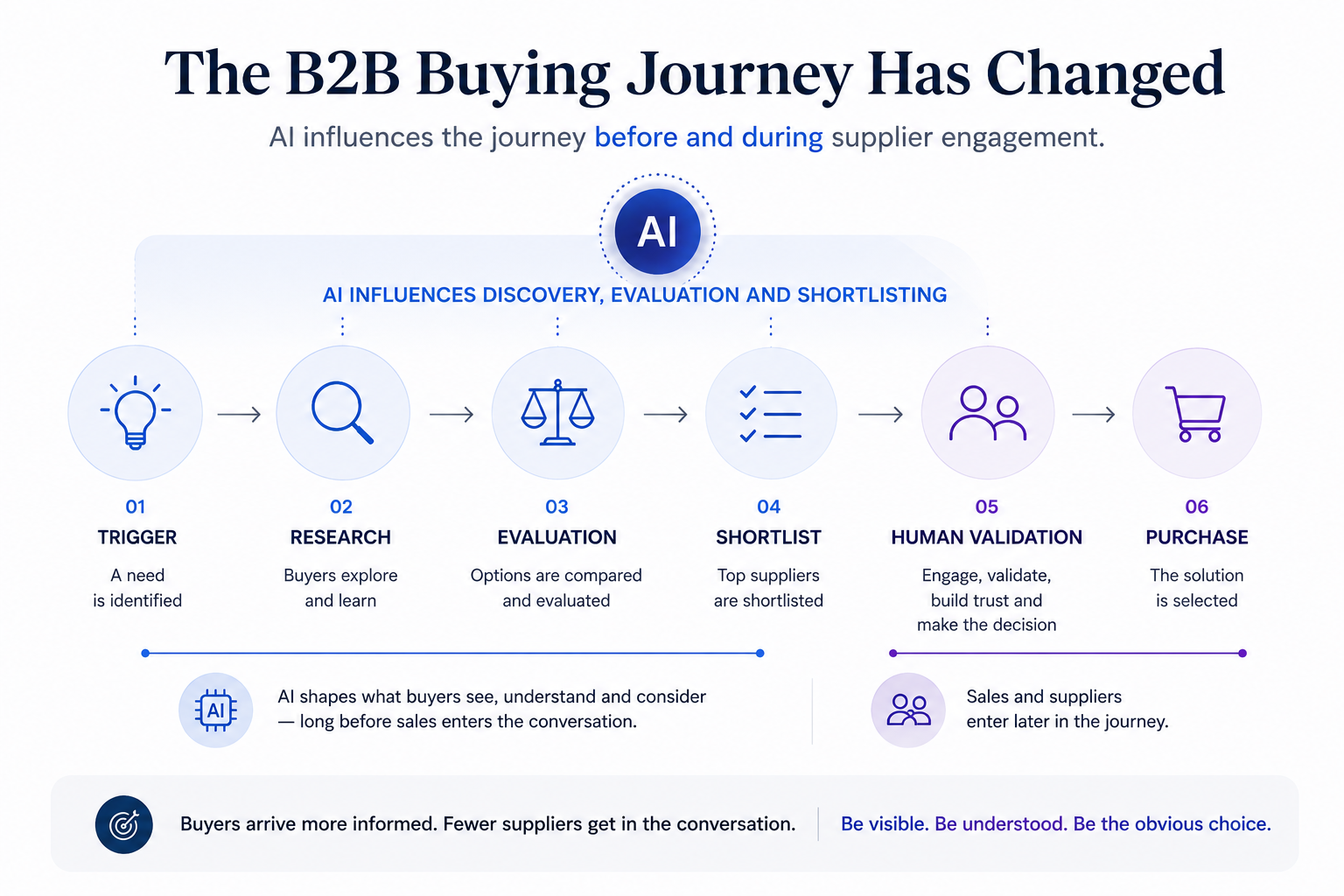
Your buyer may already have shortlisted competitors before your sales team even knows they exist.
That is one of the biggest commercial shifts happening in B2B right now, yet many companies are still operating as though the buying journey works the same way it did five years ago. It does not.
Today’s buyers are increasingly using ChatGPT, Perplexity, Google AI Overviews, review platforms, LinkedIn research, competitor comparisons, and AI assisted analysis long before they ever speak to suppliers directly. The result is that sales conversations are happening later, buyer expectations are higher, and marketing content now plays a much larger role in shaping commercial decisions before a company even knows a buyer exists.
This shift is not theoretical. It is already happening.
According to Gartner, nearly half of B2B buyers now use AI during purchasing processes, while many buyers increasingly prefer supplier free or self directed research experiences:
https://www.gartner.com/en/newsroom/press-releases/2026-03-09-gartner-sales-survey-finds-67-percent-of-b2b-buyers-prefer-a-rep-free-experience
At the same time, 6sense research suggests buyers may complete much of the buying journey before engaging directly with suppliers:
https://6sense.com/science-of-b2b/buyer-experience-report-2025/
AI is accelerating this behaviour dramatically. Businesses are no longer competing only for human attention. Increasingly, they are competing for AI visibility, AI understanding, and AI recommendation. The risk is not simply lower search traffic. The risk is becoming invisible during AI mediated supplier shortlisting.
Buyers Are Researching Before Sales Ever Knows
Traditional B2B sales models were built around controlling information access. That model is weakening quickly because buyers can now gather competitor comparisons, pricing expectations, implementation considerations, supplier reviews, technical summaries, use cases, and market analysis within minutes using AI assisted tools.
Instead of contacting multiple suppliers early in the process, buyers increasingly narrow their shortlist before making first contact. This compresses the discovery stage of the buying journey and changes the role of both marketing and sales teams.
The first sales conversation increasingly happens after buyers already understand the market, know the terminology, have reviewed competitors, formed early preferences, identified perceived risks, and often generated internal summaries using AI. Marketing is no longer simply creating awareness. It is increasingly shaping the commercial understanding buyers develop before human engagement even begins.
Sales is also changing. Its role is moving away from basic education and increasingly towards validation, reassurance, commercial confidence, and strategic guidance. Buyers now arrive more informed and with significantly higher expectations than they did even a few years ago.
AI Search Is Changing Supplier Discovery
Search itself is changing.
For years, companies focused primarily on traditional SEO and ranking webpages in Google. That still matters, but the environment is evolving quickly. Buyers increasingly encounter Google AI Overviews, ChatGPT responses, Perplexity summaries, AI generated comparisons, AI assisted procurement research, and “zero click” search experiences where information is summarised before users even visit a website.
In many cases, buyers no longer need to visit multiple websites to gather information. AI systems increasingly summarise markets, compare providers, and surface recommendations directly.
Forrester has described this shift as part of the rise of “zero click buying”, where buyers increasingly gather information and form supplier preferences before directly engaging vendors:
https://www.forrester.com/blogs/b2b_buyers_make_zero_click_buying_number_one/
This creates a new commercial challenge: can AI systems clearly understand what your company actually does?
At Twibill Intelligence, we increasingly think about this as commercial legibility. Commercial legibility is the ability for both humans and AI systems to quickly understand what your company does, who it helps, what problems it solves, how it differs from competitors, and why it should be shortlisted.
This is where SEO, AEO, and GEO become increasingly important.
SEO, or Search Engine Optimisation, focuses on improving visibility in traditional search engines such as Google and Bing. AEO, or Answer Engine Optimisation, focuses on making content understandable and quotable by AI systems and answer engines such as ChatGPT, Perplexity, Google AI Overviews, and voice assistants.
GEO, or Generative Engine Optimisation, goes further. It focuses on helping AI systems understand what your business does, who you help, what problems you solve, how your workflows create value, and when your company should be recommended.
In simple terms, businesses now need to become more machine readable. If positioning is vague, fragmented, or inconsistent, AI systems struggle to understand and recommend the company effectively.
Most SME Marketing Is Not Ready For AI Driven Discovery
Many SMEs still operate with fragmented commercial systems. Messaging is often inconsistent across websites and sales materials. Service descriptions are vague. Case studies are weak or disconnected from real commercial outcomes. CRM systems are underused, sales and marketing teams operate separately, and content strategies are often reactive rather than structured.
Historically, companies could often compensate for this through relationships, networking, outbound sales, referrals, or reputation. But AI driven discovery changes the dynamic because AI systems depend on clarity, structure, consistency, and contextual relevance.
If a website vaguely says:
“We provide innovative business solutions for growth”
AI systems learn almost nothing meaningful.
Now compare that to:
“We help SMEs redesign marketing and sales workflows using human led AI systems that improve commercial efficiency, reporting, and decision consistency.”
The second statement immediately provides audience clarity, operational context, service definition, and commercial relevance. This matters not only for AI systems, but also for buyers themselves. Clear businesses reduce buying friction and increasingly, clarity becomes competitive advantage.
AI Visibility Starts With Operational Clarity
Many companies are currently approaching AI backwards. They focus immediately on chatbots, automation software, AI agents, or AI content generators without first improving the workflows those tools operate within.
But AI often amplifies existing operational weaknesses. If workflows are fragmented, data is inconsistent, and processes are unclear, AI systems simply accelerate confusion faster.
The companies seeing the strongest results are often not the companies using the most AI tools, but the companies with clearer workflows, stronger operational alignment, more structured commercial processes, cleaner information systems, and more consistent decision making.
This is particularly important for SMEs. AI adoption is increasingly becoming less about replacing humans and more about improving workflow quality, speed, consistency, and commercial visibility.
Research reported by Demand Gen Report and G2 also suggests many B2B software buyers are now using AI chatbots during supplier and software research processes:
https://www.demandgenreport.com/industry-news/news-brief/half-of-b2b-software-buyers-now-start-their-research-with-ai-chatbots-g2/
This reinforces how AI is increasingly becoming part of the discovery and evaluation layer within B2B purchasing.
At Twibill Intelligence, we increasingly see that companies achieve stronger AI adoption outcomes when they first improve workflow clarity, operational alignment, and commercial visibility before implementing AI tools. This is one of the reasons we developed our AI workflow audit approach.
The Companies That Win Will Be Easier To Understand
The B2B buying journey is becoming increasingly compressed, AI assisted, and research driven. Buyers are arriving later, more informed, and expecting clearer answers faster.
At the same time, AI systems are becoming a growing layer between buyers and suppliers. That means businesses must increasingly optimise not only for human attention, but also for machine understanding.
In the next phase of B2B buying, companies will not compete only on products, pricing, or marketing. They will increasingly compete on how understandable they are to both humans and machines.
The companies that will perform best are likely to be those that clearly communicate what they do, who they help, what outcomes they create, how they differ, and how their workflows and expertise create value.
In many ways, this is not simply a marketing challenge.
It is an operational clarity challenge.
And increasingly, operational clarity becomes commercial advantage.
Research & References
Gartner — B2B buyers increasingly prefer supplier free research experiences
https://www.gartner.com/en/newsroom/press-releases/2026-03-09-gartner-sales-survey-finds-67-percent-of-b2b-buyers-prefer-a-rep-free-experience
Gartner — Buyers still rely on sales teams to validate AI generated insights
https://www.gartner.com/en/newsroom/press-releases/2026-05-20-gartner-survey-finds-sixty-nine-percent-of-b-two-b-buyers-turn-to-sales-reps-to-validate-ai-generated-insights
6sense — B2B buyer journey research
https://6sense.com/science-of-b2b/buyer-experience-report-2025/
Forrester — The rise of “zero click buying”
https://www.forrester.com/blogs/b2b_buyers_make_zero_click_buying_number_one/
Demand Gen Report / G2 — AI chatbot usage in B2B buying research
https://www.demandgenreport.com/industry-news/news-brief/half-of-b2b-software-buyers-now-start-their-research-with-ai-chatbots-g2/
At Twibill Intelligence, we believe the next phase of commercial advantage will come not simply from using more AI, but from becoming easier for both humans and machines to understand.
FAQs
How is AI changing the B2B buying journey?
AI allows buyers to research suppliers, compare competitors, summarise markets, and evaluate options before speaking directly to sales teams. This compresses discovery stages and shifts sales conversations later into the buying process.
What is GEO in marketing?
GEO stands for Generative Engine Optimisation. It focuses on making businesses understandable and recommendable by AI systems such as ChatGPT, Perplexity, and AI search engines.
What is the difference between SEO, AEO, and GEO?
SEO focuses on ranking in search engines. AEO focuses on becoming part of AI generated answers. GEO focuses on helping AI systems understand and recommend businesses accurately.
Are B2B buyers using ChatGPT for supplier research?
Yes. Multiple studies suggest B2B buyers increasingly use AI tools such as ChatGPT and Perplexity during supplier research, market analysis, and early stage buying evaluation.
How should SMEs adapt their marketing for AI search?
SMEs should improve positioning clarity, structure website information more clearly, align sales and marketing workflows, strengthen case studies, and create content that is understandable to both humans and AI systems.