
Most Businesses Already Have AI. Why Aren’t They Seeing Better Results?
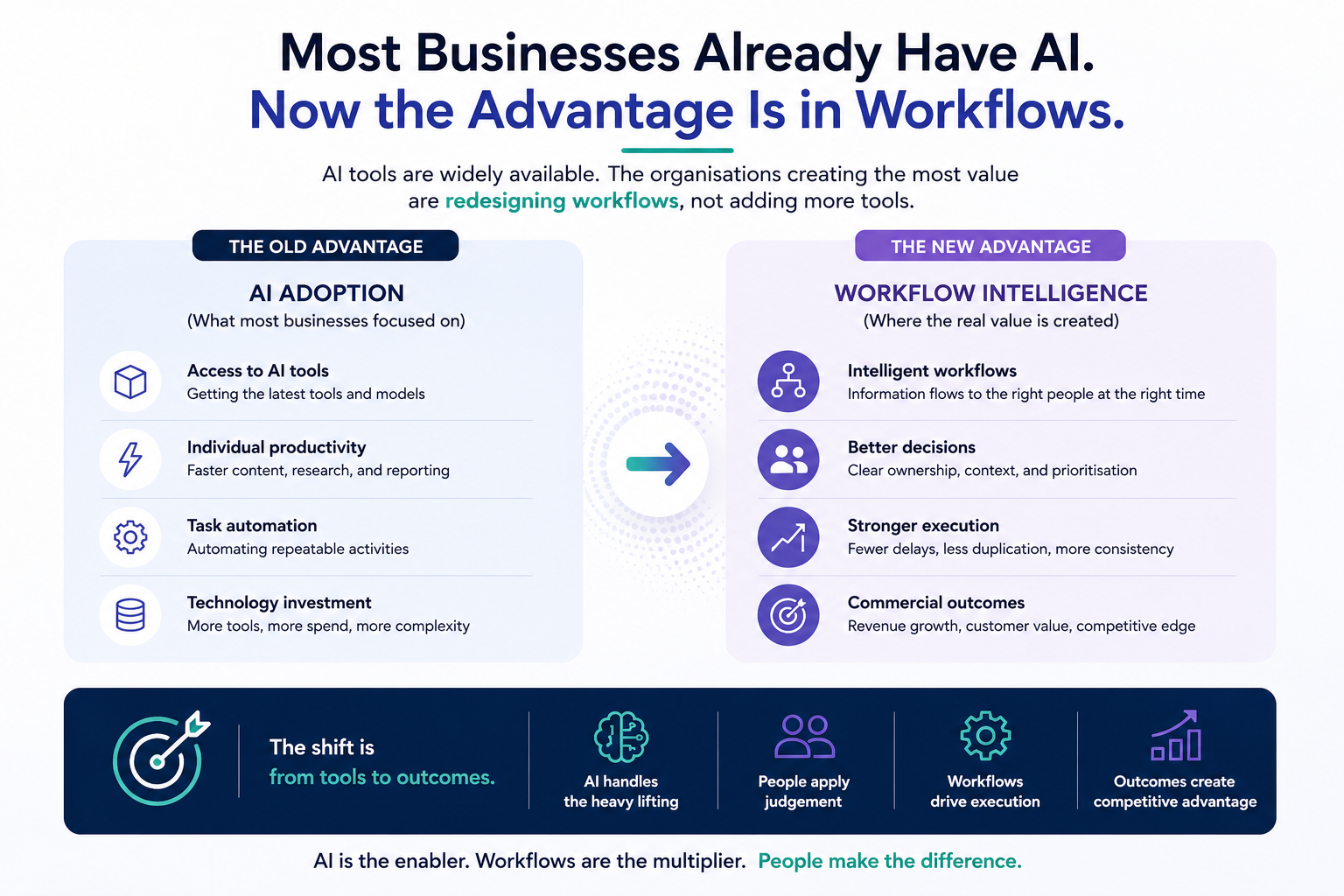
Key Takeaways
Most AI initiatives fail to create meaningful value because workflows remain unchanged.
Workflow redesign has a greater impact on business outcomes than tool adoption alone.
The next competitive advantage is workflow intelligence, not AI access.
AI should support judgement, not replace it.
The best starting point is understanding how information, decisions and actions move through the organisation.
For much of the last two years, the business conversation around AI has focused on adoption.
Companies have experimented with ChatGPT, Microsoft Copilot, Claude, Perplexity and an expanding range of AI-enabled tools. Marketing teams have accelerated content production. Sales teams have improved prospect research. Leadership teams have begun using AI to summarise reports, analyse information and support decision making. Today, however, the conversation is changing.
For most businesses, the question is no longer whether to adopt AI. That decision has already been made. The more important question is why widespread AI adoption is not always translating into meaningful commercial outcomes.
This shift matters because access to AI is becoming increasingly commoditised. Most organisations can access similar tools, similar models and broadly comparable capabilities. The competitive advantage is therefore moving away from access and towards something far more difficult to replicate: how effectively information, decisions and actions move through the organisation.
Recent research supports this view. Deloitte reports that organisations continue to increase investment in AI, yet many still struggle to realise measurable returns from those investments. At the same time, McKinsey’s latest research found that workflow redesign had one of the strongest influences on whether organisations achieved meaningful financial impact from generative AI. Yet only a minority of organisations reported fundamentally redesigning workflows around AI adoption.
The implication is significant. Many businesses have successfully adopted AI but far fewer have redesigned the work that AI is supposed to improve.
The AI Conversation Is Still Focused On Tools
Much of the discussion surrounding AI remains focused on technology. Every week brings a new model, a new agent, a new automation platform or a new productivity tool. While these developments are important, they often distract attention from a more practical question:
How does work actually get done inside the business? Most organisations do not struggle because they lack access to technology. They struggle because information moves slowly, ownership becomes unclear, decisions are delayed, teams operate with different assumptions and important handoffs break down.
Marketing generates leads that sales does not prioritise. Customer intelligence exists across inboxes, CRM systems and spreadsheets but never reaches decision makers. Reports are generated regularly but rarely influence action. Multiple employees research the same accounts independently, creating duplicated effort despite widespread AI adoption.
These challenges are rarely caused by a lack of AI, they are often caused by weaknesses in the workflow itself. This is where much of the current AI narrative becomes incomplete. The conversation is often about tools, but the challenge is often execution.
Bain makes a similar observation in its research on AI transformation, arguing that organisations remain focused on AI as a technology layer when the real opportunity lies in redesigning how work is performed. The organisations seeing the greatest returns are not simply deploying tools. They are rethinking processes, operating models and decision making structures.
In other words, the challenge is no longer just AI adoption, it’s workflow intelligence.
Why Faster Tasks Do Not Automatically Create Better Results
One of the most common assumptions surrounding AI is that making individual activities faster will automatically improve business performance. In practice, organisations rarely operate through isolated tasks. A marketing team may use AI to generate content twice as quickly, a sales team may research prospects in minutes rather than hours, leaders may receive reports faster than ever before.
Yet conversion rates, customer acquisition, response speed and commercial performance may remain largely unchanged. Why? Because businesses operate through workflows rather than individual activities. A lead generated by marketing still needs qualification, a qualified lead still requires follow up, customer insights still need to reach decision makers, commercial priorities still need alignment and execution still needs ownership.
Improving one activity while leaving the surrounding workflow unchanged often shifts bottlenecks rather than removing them. Faster content creation does not solve weak lead handling. Faster reporting does not solve poor decision making. Faster research does not solve inconsistent follow up.
This helps explain why many organisations experience productivity gains without seeing equivalent gains in revenue growth, conversion performance or commercial effectiveness. The workflow remains the limiting factor.
The Missing Layer: Commercial Workflow Intelligence
When businesses think about AI, they often focus on individual activities. Marketing teams look at content creation. Sales teams look at prospect research. Leadership teams look at reporting and analysis.
The problem is that businesses do not operate through isolated activities. They operate through connected workflows.
A customer opportunity might begin with a market signal, move into targeting and demand generation, pass through lead qualification and sales engagement, and eventually become a proposal, a customer and a long term account. Every stage depends on the quality of the stage before it. If information is incomplete, if ownership is unclear or if handoffs are weak, performance suffers regardless of how much AI is being used.
This is why many organisations experience an interesting contradiction. They can point to individual examples of AI improving productivity, yet still struggle to improve overall commercial performance. Content is produced faster, but lead handling remains inconsistent. Account research takes less time, but follow up remains fragmented. Reports arrive more quickly, but decisions do not.
In these situations, the bottleneck is rarely the individual task. More often, it is the workflow connecting those tasks together.
This is where commercial workflow intelligence becomes important. Rather than asking where AI can be deployed, leaders may need to ask a more fundamental question: how does information move through the organisation, and where does value become trapped before it reaches a decision or an action?
What We Are Beginning To See Inside SMEs
Through ongoing discussions and workflow reviews with SMEs, several recurring themes continue to emerge. AI tools are often already present across marketing, sales and operations.
However, organisations frequently continue to experience fragmented market intelligence, inconsistent lead handling, duplicated research effort, disconnected systems, weak follow up discipline, reporting without action and poor coordination between teams.
In some businesses, AI is being used to create content, summarise meetings and support research, yet lead handling processes remain largely unchanged. In others, customer intelligence exists but remains trapped within individuals rather than embedded into workflows.
We are also seeing situations where reporting is generated faster than before, but faster reporting does not necessarily lead to faster decisions. Marketing and sales teams often possess different versions of the truth. Commercial priorities are not always shared. Valuable insights remain trapped in systems rather than informing action.
These are not simply technology problems, they are workflow problems. In a current commercial workflow review with a professional services organisation, one of the central questions being explored is not whether AI exists within the business.
The question is how information moves between market intelligence, marketing activity, sales follow up, reporting and commercial decision making. The tools are already present. The workflow remains the larger opportunity.
The AI Value Ladder
One useful way to think about this evolution is through a simple progression, most organisations begin with AI tools. They then apply those tools to individual tasks such as drafting, research, reporting and preparation. The next stage is embedding AI into workflows so that information moves more effectively between people, teams and decisions.
The most advanced stage goes beyond workflows altogether and begins to resemble what BCG describes as an AI-enhanced operating model, where people, processes, governance, technology and AI capabilities work together as part of a coordinated system.
This progression can be thought of as:
AI Tools → AI Tasks → AI Workflows → Human Led Intelligence Systems
Many organisations currently operate at the first two stages. The greatest long term value increasingly emerges at the latter stages. This progression matters because it reinforces a principle that sits at the centre of Twibill Intelligence’s approach: AI should support work, not replace judgement.
The organisations creating the greatest value from AI are not removing humans from the process. They are redesigning workflows so that AI improves preparation, analysis, coordination and consistency while people remain responsible for prioritisation, interpretation, approval and decision making.
What Good Looks Like
The objective is not to automate everything, the objective is to create better execution. In practice, this often means information flowing more consistently across teams, marketing and sales operating from shared context, clearer ownership of decisions, faster responses to market signals and stronger lead qualification.
Customer intelligence becomes easier to access, research becomes easier to share, AI supports preparation and analysis. People spend less time gathering information and more time making decisions. The technology becomes part of the workflow rather than sitting alongside it. This is what workflow intelligence looks like in practice.
What To Avoid
Many organisations continue to make the mistake of introducing AI into workflows they do not fully understand. This can create more activity without creating more value.
Common pitfalls include adding tools without understanding existing workflows, automating poor processes, focusing heavily on productivity metrics while ignoring decision quality, deploying disconnected AI initiatives and assuming technology can replace ownership or judgement. Workflow redesign alone is not a guarantee of success, nor will every AI initiative create measurable value.
However, organisations that understand how information, decisions and actions move through their business are typically in a much stronger position to identify where AI can genuinely help.
Where Should Businesses Start?
The answer is not necessarily another AI platform. A better starting point is understanding the current workflow, map the flow of information from initial market signal through to customer outcomes, identify where AI already exists. Look for delays, duplicated effort, weak handoffs and decision bottlenecks, understand where ownership is unclear and where commercial priorities become disconnected.
Only then should organisations decide where AI can genuinely improve speed, consistency, coordination or decision quality.
Accenture describes this challenge as process reinvention rather than technology deployment. The organisations generating the greatest value are often redesigning end to end workflows before deciding where additional AI capabilities should be introduced.
The most useful starting point is often a workflow review, understanding where information originates, where decisions are made and where delays occur provides a far clearer picture of where AI can create meaningful value.
Conclusion
Most businesses have already completed the first phase of AI adoption. The next challenge is not finding another tool, it is understanding how work flows through the organisation and redesigning those workflows to create better outcomes.
As AI becomes more accessible, the organisations that outperform their competitors may not be those using the most AI. They may be the organisations that best understand how information, decisions and actions move through their business and which have redesigned those workflows to make better use of both human judgement and machine intelligence.
AI adoption is becoming commonplace, Workflow intelligence is becoming the competitive advantage. For leaders looking to improve performance, that may be the more important conversation.
Further Reading
McKinsey — The State of AI: How Organizations Are Rewiring to Capture Value
https://www.mckinsey.com/capabilities/quantumblack/our-insights/the-state-of-ai-how-organizations-are-rewiring-to-capture-valueBain & Company — Unsticking Your AI Transformation
https://www.bain.com/insights/unsticking-your-ai-transformation/BCG — AI Transformation Is a Workforce Transformation
https://www.bcg.com/publications/2026/ai-transformation-is-a-workforce-transformationDeloitte — How to Master Value Realisation with Your AI Customer Agents
https://www.deloitte.com/nl/en/services/consulting/perspectives/how-to-master-value-realisation-with-your-ai-customer-agents.htmlAccenture — Making Reinvention Real with Generative AI
https://www.accenture.com/us-en/insights/consulting/making-reinvention-real-with-gen-ai
Frequently Asked Questions
Why isn’t AI delivering the results many businesses expected?
Many organisations have improved individual activities using AI but have not redesigned the workflows those activities sit within. Productivity gains do not automatically translate into better commercial outcomes.
What is workflow intelligence?
Workflow intelligence is the ability to understand, improve and coordinate how information, decisions and actions move through a business. It focuses on execution rather than individual tools.
What is the difference between AI tools and AI workflows?
AI tools support specific tasks. AI workflows embed those tools into connected business processes that improve how work gets done and how decisions are made.
Should businesses redesign workflows before investing in more AI?
Not necessarily. Many businesses already have AI. The more useful approach is to understand current workflows, identify where AI already exists and then redesign processes to improve coordination, decision quality and execution.
What is a Human Led Intelligence System?
A Human Led Intelligence System combines people, processes, technology, data and AI within a coordinated workflow. AI supports preparation, analysis and coordination, while people remain responsible for judgement, prioritisation and decision making.