
The Big Consultancies Have Quietly Changed Their AI Conversation. SMEs Should Pay Attention.
Over the past two years, AI has become almost impossible to avoid. New tools appear every week, headlines regularly predict dramatic changes to work, and business leaders are constantly being told that they need an AI strategy. For many SMEs, the challenge is no longer understanding what AI is. The challenge is understanding where it genuinely creates value.
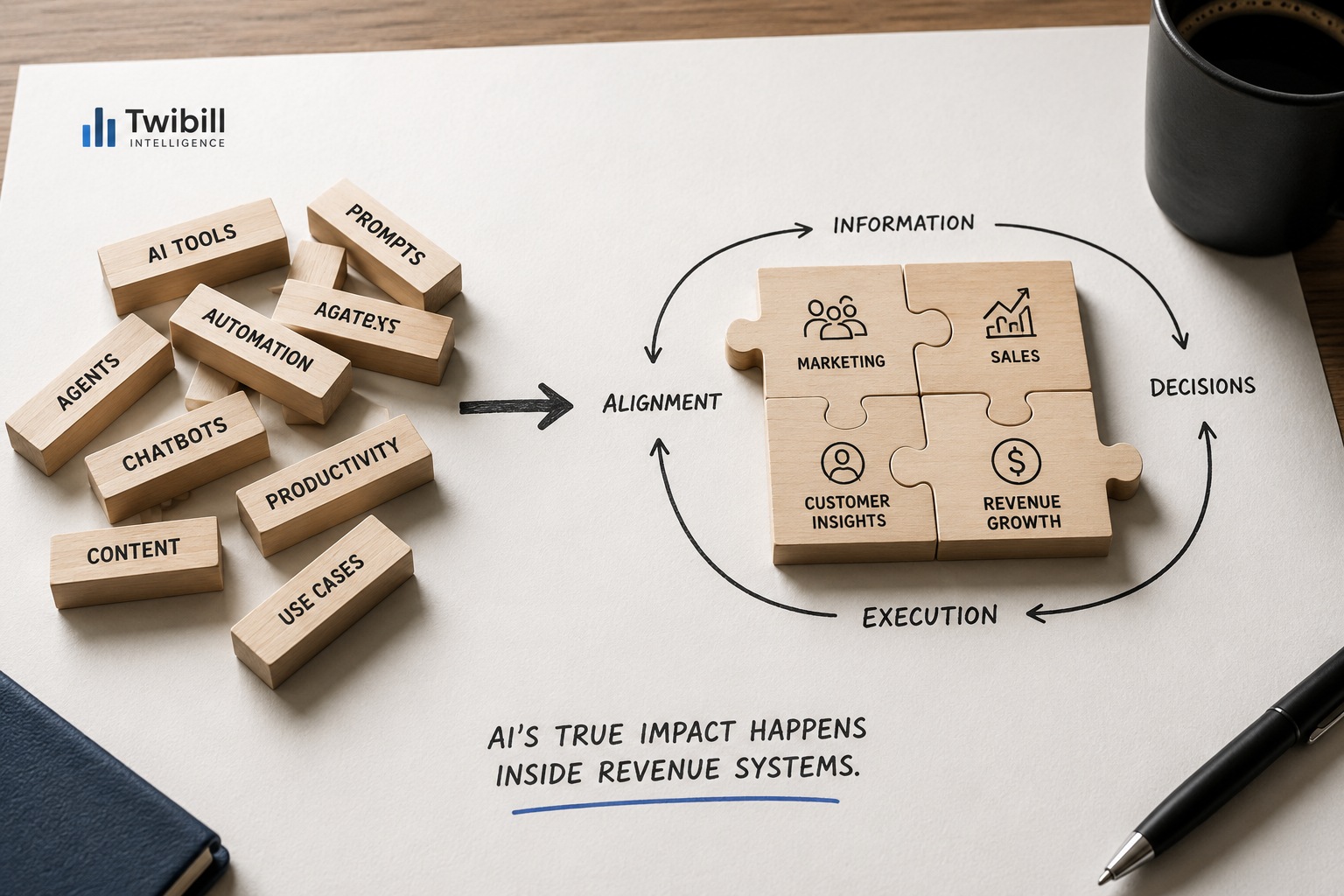
This is one reason why the latest thinking emerging from firms such as McKinsey, BCG, Bain and Deloitte is worth paying attention to. While much of the public conversation remains focused on tools, prompts and automation, many of the world’s largest consulting firms appear to be focusing on something quite different. Increasingly, they are discussing AI in the context of revenue systems, commercial execution, customer journeys and operating models.
At first glance, this may seem like a subtle distinction. In practice, it represents a significant shift in how AI is being positioned inside organisations. The conversation is moving away from what AI can do in isolation and towards how AI contributes to the systems through which businesses generate revenue, make decisions and coordinate activity.
That shift matters because most businesses do not succeed or fail because of technology alone. They succeed or fail because of how effectively they identify opportunities, share information, prioritise resources and execute consistently. Technology can support those activities, but it rarely replaces them.
From AI Tools To Revenue Systems
Much of the early enthusiasm around generative AI was understandable. Businesses quickly discovered that tools such as ChatGPT could draft content, summarise meetings, support research and automate a variety of administrative tasks. These use cases remain valuable and, for many organisations, they have delivered genuine productivity improvements.
However, productivity and commercial performance are not necessarily the same thing.
A marketing team may create content more quickly, but that does not automatically generate more qualified opportunities. A sales team may save time preparing proposals, but that does not guarantee higher conversion rates. Faster execution only creates value when it improves outcomes that matter to the business.
This is where recent consultancy research becomes particularly interesting.
McKinsey’s latest State of AI research found that organisations reporting revenue increases from AI most commonly see those benefits in marketing and sales, strategy and corporate finance, and product and service development.
Source:
https://www.mckinsey.com/capabilities/quantumblack/our-insights/the-state-of-ai
Similarly, BCG has increasingly positioned AI as a natural fit for Revenue Operations, arguing that the technology can help organisations move beyond reporting and prediction towards execution and action.
Source:
https://www.bcg.com/publications/2025/ai-was-made-for-revops-from-prediction-to-execution
Bain continues to highlight sales as one of the most significant opportunities for AI-enabled productivity and effectiveness improvements.
Viewed separately, these are individual research findings. Viewed together, they suggest a broader pattern. The most serious discussions about AI are becoming increasingly connected to revenue generation rather than standalone productivity.
The important question for SMEs is not whether they need enterprise-scale AI programmes. It is whether they understand the underlying shift taking place.
The Gap Between AI Adoption And Business Value
One of the weaknesses in much of the current AI discussion is the assumption that adopting more tools automatically leads to better outcomes. In reality, many businesses are discovering that technology adoption and value creation are very different things.
A growing business may have access to AI tools, a CRM platform, marketing automation software and customer data. Yet despite these investments, commercial performance can remain frustratingly inconsistent.
Marketing may generate enquiries that never receive meaningful follow-up. Sales teams may hold valuable customer conversations that remain trapped in meeting notes and inboxes. CRM systems may contain information that nobody fully trusts. Forecasts may rely more on individual judgement than repeatable processes.
None of these issues are unusual. In fact, they are common across many growing organisations.
The challenge is that these problems are not fundamentally technology problems. They are coordination problems. They are workflow problems. They are information flow problems.
This is where many AI initiatives begin to struggle.
Technology can process information, summarise activity and identify patterns, but it cannot automatically resolve unclear ownership, weak handoffs, inconsistent qualification criteria or disconnected teams. If those issues remain unchanged, AI often becomes another layer placed on top of an existing problem rather than a solution to it.
Recent research reported by Reuters found that while adoption of generative AI continues to rise among mid-sized businesses, many organisations still struggle to achieve meaningful operational gains.
This should not be surprising. Businesses rarely create sustainable value simply by adding technology. Value is usually created when technology improves how work is actually performed.
What SMEs Should Learn From The Enterprise Conversation
It would be a mistake for SMEs to assume they should replicate the strategies of large enterprises. Most smaller organisations do not have dedicated transformation teams, specialist data functions or the budgets required to support large-scale programmes.
However, there is a useful lesson hidden within the enterprise conversation.
The major consultancies are increasingly talking about customer acquisition, sales effectiveness, revenue operations, decision support and commercial execution. In other words, they are focusing on the activities that directly influence business performance.
For SMEs, the practical implication is straightforward. Rather than beginning with technology, it often makes more sense to begin with commercial friction.
Where do leads go cold?
Where does information become trapped?
Where are decisions delayed?
Where are handoffs inconsistent?
Where do teams duplicate effort?
Where is visibility poor?
These questions often reveal more about a company’s AI opportunities than any software demonstration ever could.
A founder does not necessarily need an AI roadmap. They may need a clearer lead qualification process. A commercial director may not need another dashboard. They may need better visibility into why opportunities stall. A marketing team may not need more content generation. They may need stronger feedback loops with sales.
When viewed through this lens, AI becomes less of a technology project and more of an operational improvement tool.
The Opportunity Remains Human
Perhaps the most important lesson from the evolving consultancy conversation is that the strongest use cases still depend heavily on people.
AI can help gather information, surface patterns, prepare research, summarise conversations and improve consistency. These capabilities can create significant value. However, they do not remove the need for judgement, prioritisation and leadership.
Customers still buy from organisations they trust.
Sales teams still build relationships.
Marketing teams still shape positioning and demand.
Leaders still make decisions about priorities, investments and trade-offs.
The role of AI is not to replace these activities. Its role is to support them.
This is why the most useful way to think about AI may not be as a collection of tools at all. A more productive perspective is to view AI as part of a broader commercial system that helps information move more effectively, decisions happen more quickly and execution become more consistent.
That appears to be the direction many of the world’s largest consulting firms are moving towards. The lesson for SMEs is not that they need to copy enterprise transformation programmes. The lesson is that the conversation is becoming less about technology and more about performance.
As AI becomes increasingly accessible, the competitive advantage is unlikely to come from simply having the tools. It is more likely to come from how effectively organisations integrate those tools into the workflows, decisions and systems that drive commercial outcomes.
Frequently Asked Questions
What is AI revenue operations?
AI revenue operations refers to the use of AI to improve how marketing, sales and customer-facing teams coordinate information, decisions and activities across the revenue lifecycle.
Why are major consultancies focusing on revenue systems?
Because many of the most valuable AI opportunities sit within customer acquisition, sales execution, customer growth and commercial decision-making rather than isolated productivity tasks.
How should SMEs start using AI?
Most SMEs should begin by identifying workflow bottlenecks, information gaps, decision delays and execution challenges before selecting AI tools.
Is AI replacing sales and marketing teams?
No. Most successful implementations use AI to improve preparation, visibility, consistency and decision support while humans remain responsible for judgement, prioritisation and relationship building.